
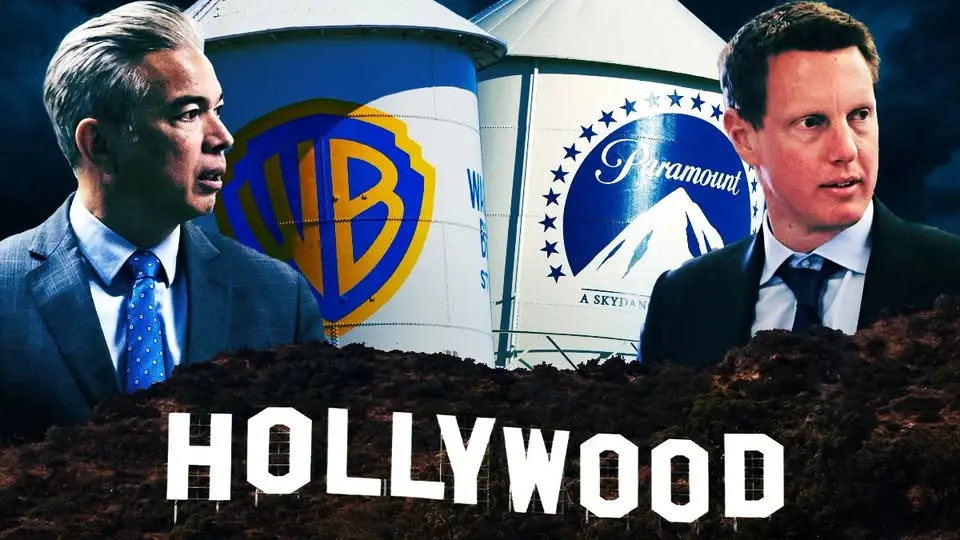
Paramount Skydance has agreed to delay closing its $111 billion merger with Warner Bros. Discovery until at least five days after an antitrust trial concludes, or June 1, 2027 — whichever comes first. The move follows a 28-day restraining order won by a 12-state coalition led by California Attorney General Rob Bonta, and effectively pushes the deal’s fate into 2027.
What Happened in the Paramount-Warner Bros. Antitrust Case?
Only a few days ago, the states’ antitrust challenge to the Paramount-Warner Bros. merger still looked like a speed bump. Now it looks more like siege warfare — Paramount has agreed to put the deal on hold for at least several months, effectively conceding it was unlikely to win an upcoming fight over a preliminary injunction. Instead, the company will try to beat the states at trial.
“I think they saw the writing on the wall,” California Attorney General Rob Bonta told Variety on Friday. “They saw that the outcome of a motion for a preliminary injunction was a fait accompli. The die was cast. They were going to lose. Otherwise, why not challenge it?”
Timeline: How the Deal Got Here
- June 2026 — The Department of Justice cleared the merger, reportedly over internal staff objections, and the European Union approved it after Paramount agreed to end its film-distribution partnership with Universal in Europe.
- July 13, 2026 — A coalition of 12 Democratic state attorneys general, led by California, filed suit to block the merger on antitrust grounds.
- Mid-July 2026 — The Writers Guild of America filed a separate antitrust suit, arguing the merger would suppress writer pay across blockbuster scripts, episodic television, and overall deals. A group of Paramount+ subscribers also sued, alleging price hikes and reduced viewing options; Judge Araceli Martinez-Olguin denied that group’s request for an injunction.
- Judge Martinez-Olguin grants a temporary restraining order — blocking the merger from closing for 28 days (through roughly Aug. 17), after finding the states had made a “strong showing” the deal was likely to harm competition.
- Paramount seeks a fast-tracked, three-day evidentiary hearing in late August, hoping to close the deal in early September before ticking fees kicked in.
- The judge declines to speed up briefing, signaling she wasn’t inclined to grant the compressed hearing Paramount wanted.
- Paramount stands down — rather than risk losing the injunction fight and facing the same appellate limbo that has trapped Nexstar’s blocked Tegna acquisition since April, Paramount agrees to freeze the deal until after a full trial.
Why Paramount Backed Down
Paramount CEO David Ellison had hoped to win a ruling denying the injunction by mid-September, letting him close the deal before Warner Bros. Discovery shareholders started collecting a $7-million-a-day “ticking fee” on Sept. 30. His legal team pushed for a compressed, three-day hearing where they could cross-examine the states’ expert economist and challenge the market-concentration argument at the heart of the case.
But Judge Martinez-Olguin’s ruling denying an expedited briefing schedule made clear she wasn’t inclined to grant that hearing — and she had already found, in issuing the 28-day restraining order, that the states made a strong showing the merger was likely to harm competition. The standard for a full injunction would be similar.
Paramount could have waited for that ruling and appealed immediately to the 9th Circuit. But Nexstar tried exactly that after its Tegna merger was enjoined in April, and remains stuck in appellate limbo with no resolution in sight. A similar outcome for Paramount likely would have pushed any relief into early 2027 anyway — so the company chose to skip the injunction fight and go straight to trial instead.
What’s Next: Trial Timing and Positioning
Paramount now says it wants to get to trial as fast as possible, ideally before the end of 2026, arguing it has the upper hand against what it calls “one of the weakest merger challenges in modern antitrust history.” Company spokespeople have framed the retreat as a strategic win, not a defeat, saying the stipulation gives them “a direct path” to a decision on the merits.
The 12-state coalition wants more time. “We do think 2027 is appropriate,” Bonta said. “If the judge said April 2027, we would not disagree with that.” The states argue they need additional discovery — documents and depositions — that Paramount and Warner Bros. didn’t hand over during the pre-litigation investigation.
“Paramount and Warner Bros. were dragging their feet. They didn’t give us everything we wanted,” Bonta said. “If they wanted to have a trial quicker, they could have given us the information we asked for in the pre-litigation discovery process.”
Regardless of when it starts, the trial itself is expected to run two to three weeks or longer, in Judge Martinez-Olguin’s Oakland, California courtroom. Under the joint stipulation, Paramount can’t close the transaction until five days after a trial ruling — or June 1, 2027, whichever is earlier.
The Money Question: Who Pays the Ticking Fee?
Even in the best case for Paramount, the trial won’t happen fast enough to avoid the $7-million-a-day fee owed to Warner Bros. Discovery shareholders starting Sept. 30, 2026. Paramount has effectively accepted that cost as the price of getting the deal done rather than risking an outright injunction loss.
Bonta pushed back on the idea that Paramount’s urgency reflects any legitimate legal timeline. “I’m sure they want a fast trial,” he said. “That’s based on other reasons, not what’s appropriate for a case of this magnitude.”
Know more details about Why Do So Many 2026 Movies Feel Confusing to Audiences?
Could Paramount and the States Still Settle?
Yes — settlement talks remain a possibility, but the two sides remain far apart. Bonta said Paramount has not offered the kind of structural remedies, such as divesting cable or film-distribution assets, that would be required for a deal. He’s repeatedly ruled out accepting “behavioral” remedies — like a consent decree guaranteeing a minimum number of film releases or 45-day theatrical windows — calling that kind of fix ineffective in similar past cases.
“We’ve never gotten anything that would come close to addressing the concerns we’ve raised,” Bonta said. “We’re focused on litigation. We’ve built momentum and we look forward to taking that momentum into trial.”
Paramount’s Response
In its statement, Paramount argued the retreat was the fastest, clearest way to prove the merger’s merits. “This is the fastest and clearest way to prove that this transaction is good for competition, good for consumers, and good for creators, a conclusion dozens of competition authorities around the world have already reached,” the company said.
Bonta sees it the opposite way. “This merger, if it is able to go through, will hurt Americans, will hurt Californians,” he said. “It will raise their prices. It shouldn’t break the bank to enjoy your favorite show on the couch.” For get latest Information’s You can visit Globlevide.
FAQ: Paramount-Warner Bros. Discovery Merger Antitrust Case
Is the Paramount-Warner Bros. Discovery merger dead?
No. The merger isn’t blocked outright — it’s paused. Paramount has agreed not to close the deal until at least five days after a trial verdict, or June 1, 2027, whichever comes first.
Why did Paramount agree to delay the merger instead of fighting the injunction?
Paramount’s lawyers concluded they were unlikely to win a preliminary injunction fight after the judge granted a 28-day restraining order and declined to fast-track a hearing. Rather than lose the injunction motion and face a long, uncertain 9th Circuit appeal — similar to the one still tying up Nexstar’s blocked Tegna merger — Paramount chose to skip ahead to a trial on the merits.
Who is suing to block the Paramount-Warner Bros. merger?
A coalition of 12 Democratic state attorneys general, led by California AG Rob Bonta, filed the primary antitrust suit on July 13, 2026. The Writers Guild of America filed a separate antitrust suit over the deal’s effect on writer pay, and a group of Paramount+ subscribers filed their own suit over potential price hikes (that suit’s request for an injunction was denied).
When will the Paramount-Warner Bros. antitrust trial happen?
No trial date has been set. Paramount wants a trial before the end of 2026; the state coalition is pushing for a later date, potentially as far out as April 2027, citing the need for more discovery.
How much is the Paramount-Warner Bros. Discovery deal worth?
The transaction is valued at roughly $111 billion.
What is the “ticking fee” in the Paramount-Warner Bros. deal?
It’s a $7-million-per-day payment owed to Warner Bros. Discovery shareholders starting Sept. 30, 2026, for as long as the deal remains unclosed — a cost Paramount has effectively agreed to absorb by delaying the transaction.
Has any regulator already approved the merger?
Yes. The U.S. Department of Justice cleared the deal in June 2026, and the European Union approved it after Paramount agreed to end its film-distribution partnership with Universal in Europe. The state AG coalition’s case is considered the most serious remaining threat to the merger.
Where will the trial be held?
In Judge Araceli Martinez-Olguin’s courtroom in Oakland, California. The trial itself is expected to last two to three weeks or longer.

Editorial Note: This article follows GlobleVide’s Editorial Policy and Fact-Checking Policy.