
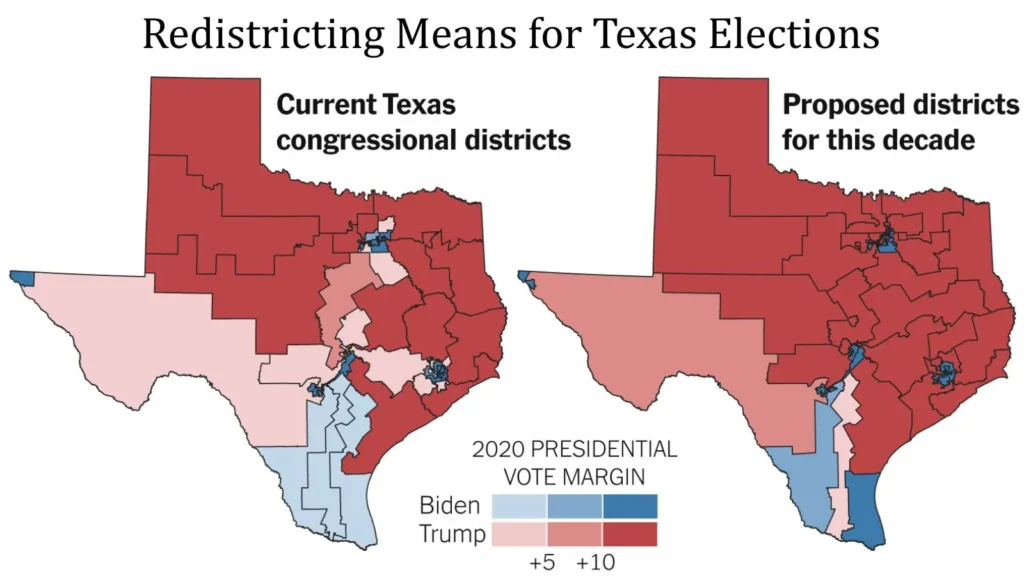
Redistricting continues to reshape political campaigns in Texas ahead of the 2026 elections, affecting congressional races, voter representation, and the future balance of power in the state. Many Texas districts have been redrawn following court decisions and population changes, and these new maps could influence both primary elections and general election outcomes. For the 2026 elections, Texas will be using a newly approved congressional map that strongly favors the Republican Party. Analysts say the new districts could give Republicans the chance to pick up as many as five additional U.S. House seats. The U.S. Supreme Court ruled on December 4, 2025, that the map can be used for the upcoming elections, temporarily pausing a lower court decision that had blocked it earlier.
For many voters, redistricting is difficult to understand, but the changes can have a major impact on which candidates win and which communities receive political representation.
Key Points
- New maps change who can win specific districts
- Some Democratic districts may become more competitive
- Republicans remain favored statewide
- Candidates are shifting races because of new maps
- 2026 Senate and House races could see unexpected outcomes
Why Texas Districts Were Changed
Redistricting happens every decade based on the U.S. Census. In Texas, population growth—especially in and around cities—led to significant changes in congressional boundaries. Some districts gained more voters, while others were redrawn to reflect new demographics.
Court rulings also influenced how certain districts were redrawn, especially in areas where legal challenges argued that maps did not properly represent communities.
What Redistricting Means for Texas Elections in 2026
New District Boundaries
For the 2026 elections, many Texas voters will find themselves in newly drawn U.S. House districts. Some voters may now belong to a different district than they did in 2024, with different candidates and new district shapes designed to favor one political party.
Republican Advantage
The map was drawn by the Republican-led Texas Legislature with the intention of increasing their representation in Congress. Analysts say the new lines are designed to secure up to five additional Republican seats by concentrating Democratic voters into fewer districts while spreading Republican voters more efficiently across others.
More Predictable Outcomes
Political analysts describe the new district lines as “durable,” meaning they are drawn in a way that strongly benefits Republicans even if Democrats make gains statewide. This makes many races less competitive and creates more predictable outcomes in several regions.
Legal Challenges Are Ongoing
Although the Supreme Court allowed the map to be used in 2026, legal challenges are still active. The lawsuit claims the map weakens the voting power of minority communities, especially Latino voters. The Supreme Court ruling was temporary and did not decide whether the map violates federal law.
National Impact
Texas’ redistricting plays a role in the broader national political picture. If Republicans pick up additional seats, it could help shift or maintain control of the U.S. House. Democratic officials in other states, including California, are already considering redistricting adjustments of their own in response, highlighting how significant the Texas map could be in national politics.
How Redistricting Affects Political Campaigns

When district lines change, candidates sometimes face more difficult paths to re-election. This can lead them to seek new offices, run in different districts, or shift their campaigns altogether.
For example, Jasmine Crockett decided to run for the U.S. Senate after new maps reportedly made her current House district more favorable for a Republican candidate. This type of shift happens when lawmakers believe their district no longer supports their election chances.
Who Benefits Most From the New Maps?
Many political experts say Republicans benefit from several of the new district boundaries, which appear to strengthen conservative areas while creating challenges for some Democratic incumbents.
However, Democrats have gained supporters in large metropolitan regions like Dallas–Fort Worth, Austin, and Houston. Over time, this could make some districts more competitive.
How Redistricting Impacts Voters
District changes can:
- change who represents you
- remove or add certain communities from a district
- affect which party has a better chance of winning
- change the issues candidates focus on
Voters may find themselves in a completely new district—even if they never moved.
Will Redistricting Change Who Wins in 2026?
Some analysts believe the new maps will help Republicans maintain statewide advantage, while others say demographic shifts could slowly increase Democratic chances.
Political experts agree that Texas remains a Republican-leaning state, but changing voting patterns could make the next elections more competitive in key districts.
What About the Senate Race?
Redistricting does not directly change statewide Senate boundaries, but it has a huge impact on which candidates decide to run statewide—as seen with Jasmine Crockett entering the Senate race in 2026.
Internal link → Jasmine Crockett Senate race
Final Thoughts
Redistricting is complicated, but it plays a major role in shaping Texas politics. New maps will influence the 2026 elections, affect candidate strategy, and determine which voices are represented in Congress.
As Texas continues to grow and change, redistricting will remain a major part of political debate in the state—and a key issue to watch in future election cycles.
FAQs
