
What is glass skin?
Glass skin is a K-beauty term for skin that is deeply hydrated, smooth, even-toned, and reflects light, like a pane of glass. It is not a makeup look. It is the result of a consistent skincare routine focused on hydration, gentle exfoliation, and daily SPF. You don’t need expensive products to achieve it. A complete glass skin routine, and it’s using drugstore products costs under $50 and results show in 4 to 8 weeks.
Key Takeaways
- Glass skin has accumulated over 2.2 billion TikTok views, making it one of the most searched beauty trends globally (Skin Science Hub, 2025).
- In 2024, glass skin was the most talked-about beauty trend on TikTok, with over 700,000 posts (Professional Beauty, 2025).
- 73% of US consumers now prioritize skin health over makeup coverage, according to Allure Magazine’s 2025 beauty trend report.
- You do not need 10 steps or luxury products. Five targeted drugstore steps, done consistently, deliver the same result.
- The four non-negotiable ingredients for glass skin are hyaluronic acid, niacinamide, a gentle AHA or BHA exfoliant, and SPF 30 or higher.
- Most people see improved texture and hydration within 2 weeks. A full glass skin transformation takes 6 to 8 weeks of daily consistency.
- In 2026, the trend has shifted to what experts call Glass Skin 2.0: less mirror-like shine, more deep hydration and a quietly luminous, healthy glow.
Table of Contents
What Glass Skin Actually Is (And What It Is Not)
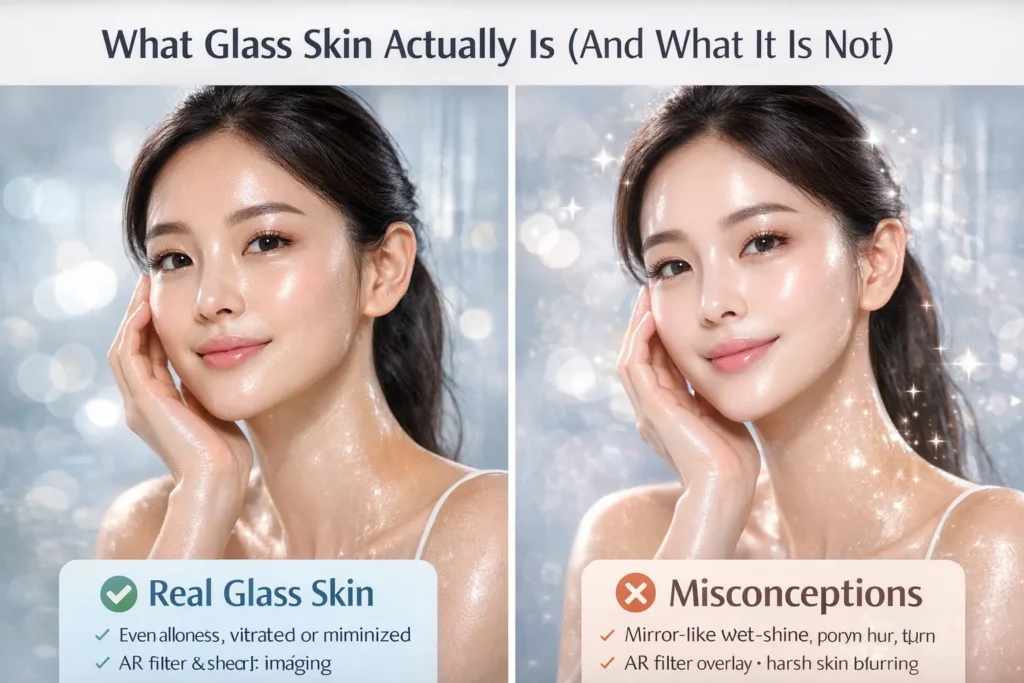
Glass skin describes skin that looks clear, smooth, plump, and so hydrated it appears almost translucent. Light bounces off the surface evenly, the way it would off polished glass. There are no dry patches, no dullness, no visible texture.
The term was coined by Korean beauty influencer Ellie Choi in 2017. It spread globally through K-drama and K-pop, where the clean, glowing skin of Korean celebrities became the aspirational standard. Alicia Yoon, founder of Peach & Lily, helped bring the concept to the US in 2018. Today it is the dominant skin goal in American beauty culture.
Here is what glass skin is not:
- It is not a filter or a makeup technique. Many TikTok videos use AR dewy-glow filters to fake the result. Real glass skin comes from the inside your routine, not from a digital overlay.
- It is not a poreless, airbrushed perfection. Visible pores are normal. Glass skin minimizes their appearance through hydration and texture refinement, but does not erase them.
- It is not the same as oily or shiny skin. The glow from glass skin comes from deep hydration. Oily shine comes from excess sebum. They look different and need different routines.
- It is not only achievable with luxury products. Every ingredient that drives glass skin results is available in drugstore formulas at CVS, Target, and Walgreens.
Glass Skin 2.0 in 2026: The trend has evolved. Where the original glass skin focused on a high-gloss, mirror-like finish, the 2026 version is about depth rather than surface shine. Runway Magazine describes it as skin that looks hydrated, elastic, and quietly luminous rather than overtly polished. The shift is from surface reflection to genuine skin health.
The 4 Ingredients That Do All the Work
You do not need a 12-product shelf. Glass skin runs on four ingredients. Find these in your drugstore products and you have everything you need.
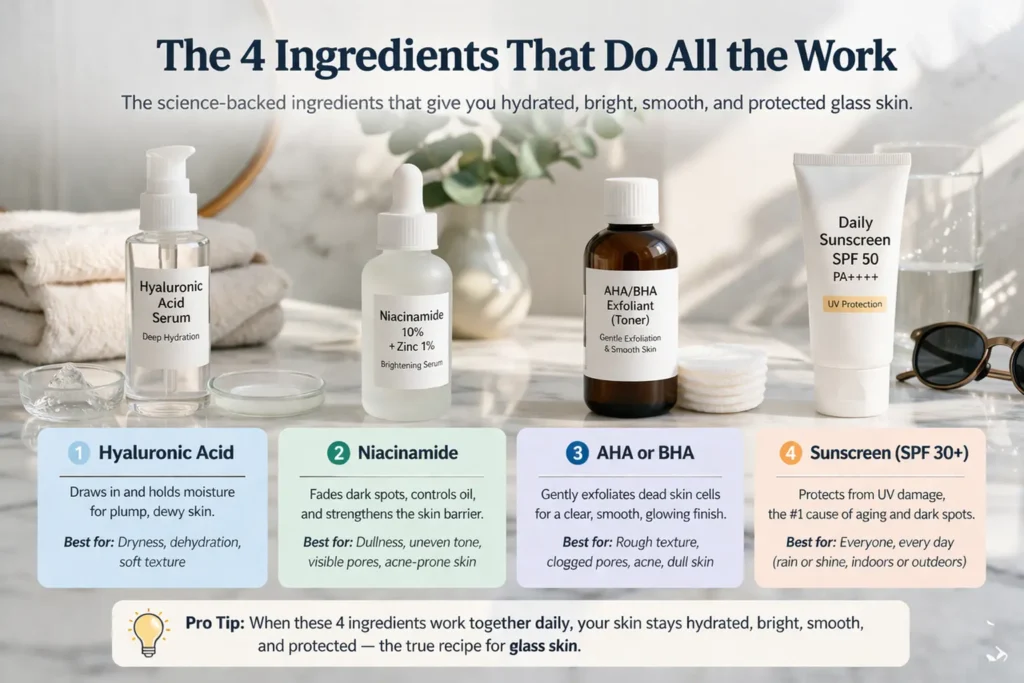
1. Hyaluronic Acid (HA)
This is the core hydration engine. Hyaluronic acid holds up to 1,000 times its own weight in water, drawing moisture from the air into your skin and keeping it there. It plumps skin cells from within, which reduces the look of fine lines and gives skin that bouncy, dewy texture.
- Apply to damp skin for best results. Dry skin absorbs less HA and some people experience tightness if applied to completely dry skin in low humidity.
- Look for products with multiple molecular weights of HA: low molecular weight penetrates deeper, high molecular weight sits on the surface for visible plumping.
- Drugstore finds: Neutrogena Hydro Boost Water Gel (~$18 at CVS), The Ordinary Hyaluronic Acid 2% + B5 (~$8 at Ulta).
2. Niacinamide (Vitamin B3)
Niacinamide is the ingredient most responsible for the even, clear, pore-minimized skin associated with glass skin. It regulates oil production, fades hyperpigmentation, strengthens the skin barrier, and visibly reduces pore size with consistent use.
- Start with 5% concentration. Higher percentages (10%+) can cause temporary flushing in some skin types.
- Pairs well with hyaluronic acid and SPF. Avoid layering directly with high-dose vitamin C (ascorbic acid) as this can cause the niacin flush reaction.
- Drugstore finds: e.l.f. Holy Hydration Niacinamide Serum (~$14 at Target), The Inkey List Niacinamide Serum (~$13 at Sephora/Ulta).
3. A Gentle Chemical Exfoliant (AHA or BHA)
Dead skin cells are the primary reason skin looks dull and textured rather than smooth and glowing. Chemical exfoliants dissolve the bonds between dead cells and lift them away without the micro-tears caused by physical scrubs.
- AHAs (glycolic acid, lactic acid): work on the skin surface. Best for dry, dull, or aging skin. Use 1 to 2 times per week.
- BHAs (salicylic acid): penetrate into pores. Best for oily, acne-prone, or congested skin. Use 1 to 2 times per week.
- PHAs (gluconolactone): the gentlest option. Best for sensitive skin. Use up to 3 times per week.
- Drugstore finds: Good Molecules Glycolic Acid Toner (~$14 at Ulta), The Inkey List 2% Salicylic Acid Toner (~$13 at Sephora), Paula’s Choice BHA Liquid Exfoliant (~$35 at Ulta, slightly above drugstore but widely available).
4. Broad-Spectrum SPF 30 or Higher
UV damage breaks down collagen, causes pigmentation, and creates the uneven texture and dullness that makes glass skin impossible to achieve. Daily SPF is not optional. It is the step that protects every other result your routine creates.
- Apply as the final morning step after moisturizer.
- Use two finger-lengths of product to cover your face and neck for full protection.
- Reapply every two hours if you are outdoors.
- Drugstore finds: Neutrogena Clear Face SPF 55 (~$14 at CVS), La Roche-Posay Anthelios Melt-In Milk SPF 60 (~$22 at CVS/Target), EltaMD UV Clear SPF 46 (~$42, above drugstore but widely recommended by US dermatologists).
New to K-beauty or want to go deeper? Explore our K-beauty step-by-step guides on double cleansing, toners, and serums to build the perfect routine tailored just for you. Dive in and level up your skincare game!
The 5-Step Drugstore Glass Skin Routine
This routine uses products available at CVS, Walgreens, Target, or Amazon. Total first-purchase cost: $45 to $65. Each product lasts 2 to 3 months.
Product order rule: apply thinnest to thickest. Lighter water-based products go first. Heavier creams and oils go last. This lets each layer absorb fully before the next seals it in.
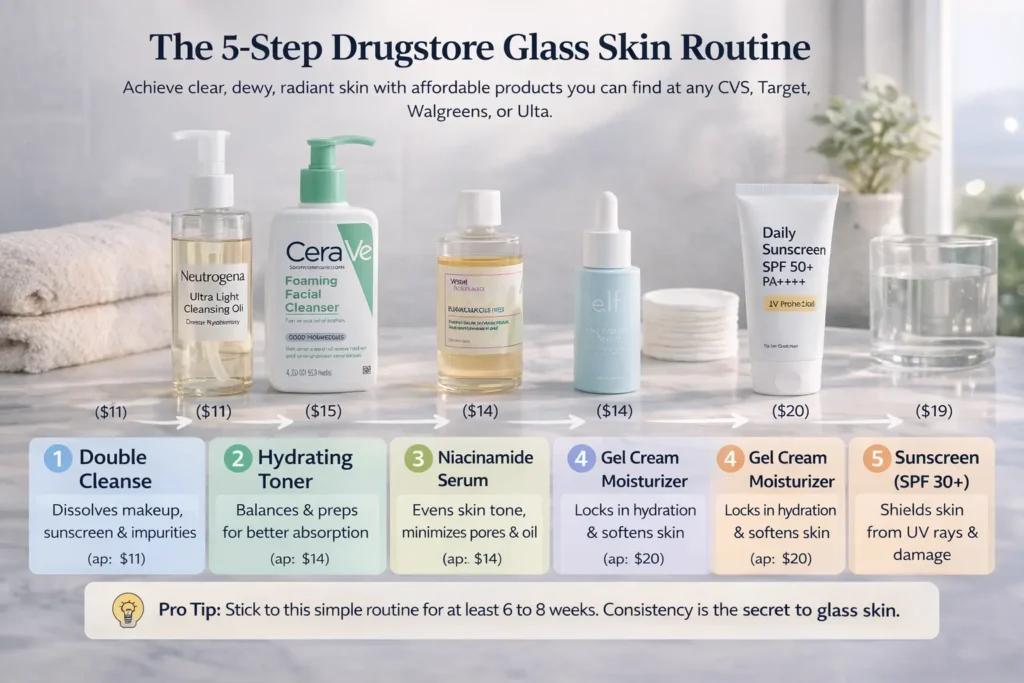
Step 1: Double Cleanse (Evening Only)
Start your evening routine with an oil cleanser to dissolve sunscreen, makeup, and excess oil. Follow with a gentle water-based cleanser. In the morning, use only the water-based cleanser.
- Oil cleanser: massage into dry skin for 60 seconds, add a few drops of water to emulsify it into a milky texture, then rinse.
- Water cleanser: apply to damp skin, massage for 30 seconds, rinse with lukewarm water. Never hot water.
- Drugstore picks: Garnier SkinActive Micellar Cleansing Oil (~$14 at Target), CeraVe Hydrating Cleanser (~$14 at CVS).
Step 2: Exfoliate (2 to 3 Times Per Week, Evening Only)
Apply your chemical exfoliant after cleansing on exfoliation nights. Skip your serum on those nights unless your skin is used to layering actives.
- Apply to clean, dry skin. Wait 5 minutes before the next step.
- Do not exfoliate more than 3 times per week. Over-exfoliation is the fastest way to damage your skin barrier and reverse all your glass skin progress.
- Always follow with moisturizer and SPF the next morning. Exfoliation increases your skin’s UV sensitivity.
Step 3: Hydrating Toner
Apply a hydrating toner immediately after cleansing while your skin is still slightly damp. This is not a Western astringent toner. It adds the first layer of hydration and preps skin to absorb what follows.
- Pour a small amount onto clean palms and pat gently into skin.
- Look for glycerin, hyaluronic acid, centella asiatica, or beta-glucan in the ingredient list.
- Drugstore pick: Neutrogena Hydro Boost Hydrating Toner (~$14 at Walgreens), TonyMoly I’m Real Sheet Mask Toner (~$18 at Ulta).
Step 4: Serum
This is where niacinamide and hyaluronic acid go to work. Apply 3 to 4 drops and pat gently into skin. Do not rub.
- Morning: vitamin C serum to brighten and protect against environmental damage. Apply before moisturizer.
- Evening: niacinamide serum or hyaluronic acid serum. On exfoliation nights, skip the active serum and use only a hydrating serum.
- Do not layer more than two serums at once. Layering too many actives increases irritation risk and reduces absorption of each one.
Step 5: Moisturizer + SPF (Morning) or Rich Moisturizer (Evening)
Moisturizer seals in all the hydration from the previous steps. Without it, toners and serums evaporate off the skin surface instead of absorbing.
- Morning: lightweight moisturizer followed by SPF as a separate, final step.
- Evening: slightly richer moisturizer or a gel-cream. Your skin repairs itself at night, so this is when heavier hydration pays off most.
- Optional evening upgrade: a sleeping mask 2 to 3 nights per week. Apply as the final step over your moisturizer. Laneige Water Sleeping Mask (~$25 at Target) is one of the best-selling K-beauty products in the US.
Looking for an Affordable Skincare Routine that fits your budget? We’ve got tips for creating a hydration-focused routine without the hefty price tag!
Best Drugstore Glass Skin Products in the US (2026)
Every product below is available at CVS, Walgreens, Target, Ulta, or Amazon. Prices are as of March 2026.
| Product | Why it works for glass skin | Price | Where to buy |
|---|---|---|---|
| CeraVe Hydrating Cleanser | Ceramides + hyaluronic acid. Cleans without stripping the barrier | ~$14 | CVS, Target, Amazon |
| Neutrogena Hydro Boost Water Gel | Pioneered the water-gel texture for glass skin. HA-rich, oil-free | ~$18 | CVS, Walgreens, Target |
| The Inkey List Niacinamide Serum | 5% niacinamide minimizes pores, fades dark spots, regulates oil | ~$13 | Sephora, Ulta, Amazon |
| The Ordinary Hyaluronic Acid 2% + B5 | Multi-weight HA for surface + deep hydration, fragrance-free | ~$8 | Ulta, Target, Amazon |
| Good Molecules Glycolic Acid Toner | 5% glycolic acid gently exfoliates and brightens without irritation | ~$14 | Ulta, Amazon |
| e.l.f. Holy Hydration Niacinamide Serum | Budget pick. Niacinamide + hyaluronic acid in one lightweight serum | ~$14 | Target, Walmart, CVS |
| La Roche-Posay Anthelios SPF 60 | Dermatologist #1 recommended SPF. Melt-in texture, zero white cast | ~$22 | CVS, Target, Walgreens |
| Laneige Water Sleeping Mask | Optional final step 2-3 nights per week. Seals in overnight hydration | ~$25 | Target, Ulta |
Total cost: $45 to $65 for a full first-purchase routine. Monthly cost drops to $18 to $28 once you have the core products and are only restocking what runs out.
Glass Skin Routine by Skin Type
The steps are the same for everyone. What changes is which products and concentrations work for your skin.
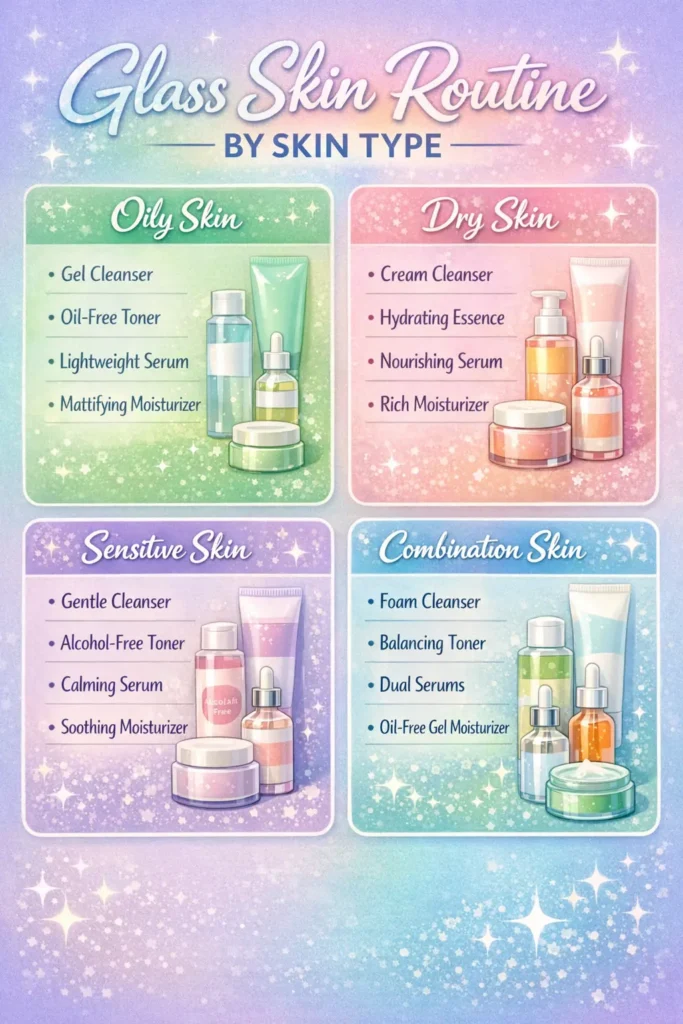
Oily Skin
- Cleanser: use a low-pH gel or foam cleanser. CeraVe Foaming Facial Cleanser (~$14) removes excess oil without over-drying.
- Exfoliant: use a BHA (salicylic acid) to clear congested pores and reduce the sebum buildup that blocks your glow.
- Serum: niacinamide is your best friend. It actively reduces oil production and pore appearance over time.
- Moisturizer: gel-cream texture only. Neutrogena Hydro Boost is the standard recommendation. Heavy creams will cause breakouts.
- SPF: a fluid or gel formula, not cream-based. Cetaphil Sheer Mineral Sunscreen SPF 50 (~$18) sits well over oily skin without adding shine.
Dry Skin
- Apply your hydrating toner while skin is still damp from cleansing. The window matters for dry skin.
- Layer: toner, then essence (snail mucin or hyaluronic acid), then a richer serum, then a ceramide-heavy cream.
- CeraVe Moisturizing Cream (~$18) with ceramides and hyaluronic acid is one of the most-recommended US drugstore picks for dry skin.
- Add a sleeping mask 3 nights per week as your final step. This is where dry skin sees the biggest glass skin gains.
- Exfoliant: use lactic acid or a PHA instead of glycolic acid. They are gentler and also hydrating.
Combination Skin
- Use the same cleanser and toner across your whole face.
- Apply a lightweight gel moisturizer everywhere, then dab a heavier cream only on dry patches (cheeks, around the mouth).
- Niacinamide works well for combination skin: it controls oil in the T-zone while improving the texture of dry areas.
- Exfoliate T-zone more frequently (twice a week) and dry zones less (once a week) if your skin tolerates it.
Sensitive Skin
- Patch test every new product on your inner arm for 48 hours before applying to your face.
- Introduce one new product every 2 weeks. Not one per day. One every 2 weeks.
- Look for fragrance-free, alcohol-free, dye-free formulas only. Any of those three in a formula is a potential irritant.
- Start with a PHA exfoliant, not AHA or BHA. PHAs are larger molecules that do not penetrate as deeply and cause significantly less irritation.
- Centella asiatica, panthenol, and allantoin are your core calming ingredients. Look for them in your toner and moisturizer.
This comfort-first approach mirrors what we’ve explored in Morning Skincare Routines That Support Skin Balance, where consistency matters more than complexity.
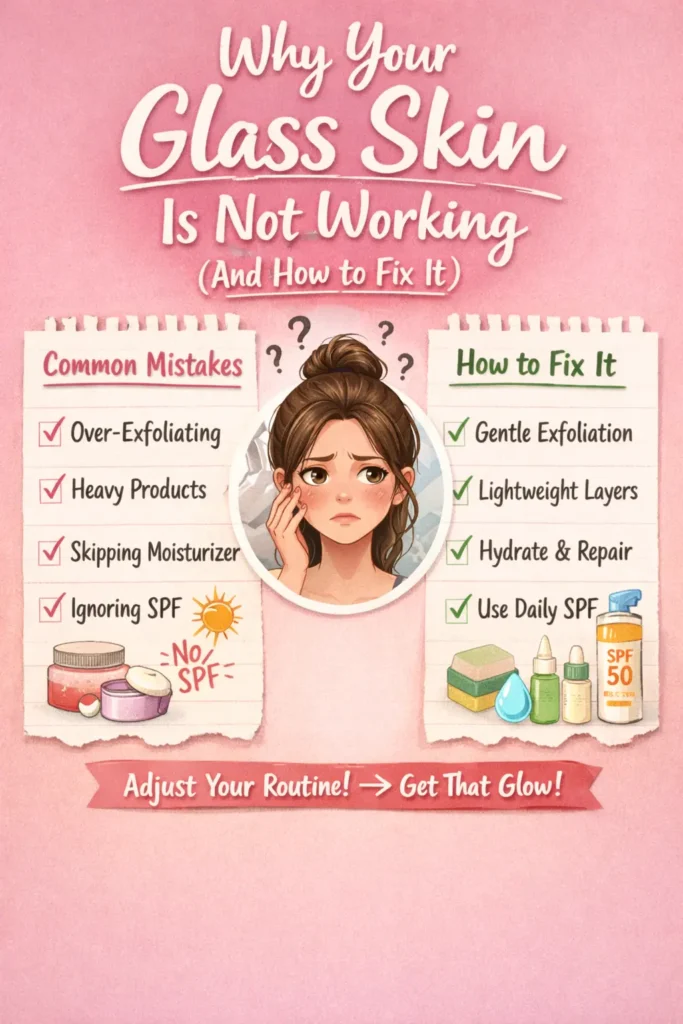
Why Your Glass Skin Is Not Working (And How to Fix It)
Most glass skin failures come from one of five predictable mistakes.
You Are Changing Products Too Often
Skin takes time to respond to a new routine. Switching products every 2 to 3 weeks means your skin never reaches the adaptation phase where results actually appear. Commit to your current products for at least 6 full weeks before deciding they do not work.
You Are Over-Exfoliating
Exfoliating daily, or combining multiple exfoliants in one routine, destroys your skin barrier. The result is redness, sensitivity, breakouts, and dullness. Exfoliate once or twice per week maximum. If your skin feels tight, stings, or reacts to products that used to work, stop all exfoliants for 2 weeks and focus only on hydration and SPF.
You Skip SPF
Every day you go without sunscreen undoes the texture improvement and brightness your routine creates. UV exposure causes pigmentation and collagen breakdown, the two things that make glass skin impossible. If you do nothing else from this article, wear SPF every morning.
You Are Using Too Many Actives at Once
Vitamin C in the morning and a BHA at night is fine. Vitamin C, BHA, AHA, niacinamide, and retinol in the same routine is too much. Start with one active per routine. Add a second only once your skin is stable and comfortable with the first.
You Are Not Drinking Enough Water
No moisturizer fully compensates for systemic dehydration. Your skin is the last organ to receive water from what you drink. Aim for 2 to 3 liters per day. You will notice a visible difference in plumpness and texture within a week of consistent hydration.
Barrier damage red flag: If your skin stings when you apply your toner or moisturizer, your barrier is compromised. Pause all actives. Use only a gentle cleanser, ceramide moisturizer, and SPF for 2 weeks. CeraVe Moisturizing Cream is the standard recovery product recommended by US dermatologists. Barrier repair takes 2 to 4 weeks of simplified routine.
Lifestyle Habits That Speed Up Glass Skin Results
Your routine does 80% of the work. These habits do the rest.
- Sleep on a clean silk or satin pillowcase. Cotton absorbs your moisturizer overnight and transfers bacteria back onto your face. Change your pillowcase every 2 to 3 days.
- Get 7 to 9 hours of sleep. Skin repairs itself during deep sleep, producing collagen and replacing damaged cells. Chronic sleep deprivation shows up in skin texture within days.
- Eat omega-3 fatty acids. Foods rich in omega-3s, like salmon, walnuts, and chia seeds, strengthen the skin barrier from the inside. A stronger barrier holds hydration more effectively.
- Reduce refined sugar. High sugar intake triggers glycation, a process that stiffens and dulls skin. Reducing sugar is one of the fastest dietary changes that shows up in skin appearance.
- Manage stress. Cortisol, the stress hormone, triggers oil production and inflammation. Both directly interfere with glass skin. Even 10 minutes of daily movement or breathwork makes a measurable difference.
Realistic Glass Skin Timeline
Based on skin cell biology, not marketing. Your skin’s outer layer (stratum corneum) fully renews itself every 28 days. That is the baseline for any visible change.
| Timeline | What you will see |
|---|---|
| Week 1 to 2 | Less surface dryness. Skin feels softer and more comfortable. Slight reduction in redness for sensitive skin types. |
| Week 3 to 4 | More even tone. Less reactivity to products. Improved bounce when you press the skin. Pores may start to look smaller. |
| Month 2 to 3 | Refined texture. Consistent natural glow without any makeup. Niacinamide dark spots beginning to fade. Barrier is stable. |
| Month 3 and beyond | Sustained glass skin results. Skin is resilient, well-hydrated, and responds well to all products. Results are maintainable with daily consistency. |
This timeline is based on actual skin cell turnover cycles (Skin Science Hub, 2025). Everyone’s timeline varies based on starting point, age, genetics, and how consistently the routine is followed.
Frequently Asked Questions
What is glass skin in simple terms?
Glass skin is deeply hydrated, smooth, clear skin that reflects light like a pane of glass. It is not a makeup finish. It comes from a consistent skincare routine built around hydration, gentle exfoliation, and daily sun protection. The term originated in K-beauty and has become the most searched skin goal in the US.
How long does it take to get glass skin?
Most people see improved texture and hydration within 1 to 2 weeks. A visible glass skin transformation takes 6 to 8 weeks of daily consistency. Skin cell turnover happens every 28 days, so changes appear gradually over that cycle. Skipping days resets your progress.
Can you get glass skin with drugstore products?
Yes. The core ingredients for glass skin, hyaluronic acid, niacinamide, chemical exfoliants, and SPF, are all available in drugstore formulas. Neutrogena Hydro Boost, The Inkey List Niacinamide Serum, and La Roche-Posay SPF are dermatologist-recommended drugstore products that deliver the same active ingredients as luxury alternatives at a fraction of the cost.
Is glass skin achievable for oily skin?
Yes. Oily skin is often better hydrated than dry skin, which actually helps. The key is using oil-free, gel-based products and a BHA exfoliant (salicylic acid) to keep pores clear. Niacinamide is the most important ingredient for oily skin glass skin routines. It regulates sebum production over time, reducing the shine that comes from excess oil rather than healthy hydration.
What is the difference between glass skin and dewy skin?
The terms are often used interchangeably, but there is a difference. Glass skin is more precise: ultra-hydrated, smooth, and almost translucent, with a high-definition, light-reflecting quality. Dewy skin is a broader term for any skin that looks soft, glowing, and hydrated. All glass skin is dewy, but not all dewy skin qualifies as glass skin. Glass skin requires refined texture and clarity in addition to the glow.
Can glass skin work for darker skin tones?
Yes. Glass skin works on all skin tones and types. For deeper skin tones, niacinamide is particularly effective at fading hyperpigmentation and evening tone. Vitamin C serums also work well. One note: some chemical sunscreens leave a white cast on darker skin. Look for tinted mineral SPF formulas, such as Black Girl Sunscreen SPF 30 (~$20 at Target), which are specifically formulated for deeper tones.
What ingredients should you avoid if you want glass skin?
Avoid alcohol denat (drying alcohol) in toners, which strips hydration. Avoid physical scrubs with walnut shells or microbeads, which cause micro-tears. Avoid combining vitamin C with strong exfoliants in the same step, as this increases irritation. Avoid heavy fragrance in products if your skin is sensitive. And avoid using retinol and exfoliating acids on the same night until your skin has built up tolerance to each separately.
Does glass skin require a 10-step routine?
No. The original 10-step K-beauty routine introduced many of these glass skin concepts, but you do not need all 10 steps to achieve the result. A focused 5-step routine with the right products produces the same outcome. The 10-step routine is for people who want to address multiple specific concerns simultaneously. Most beginners get better results starting with 5 well-chosen steps.
Related Reading on GlobleVide
- K-Beauty Skincare Routine for Beginners: Your Complete US Guide (2026)
- Skin Barrier Repair: What It Means and How to Fix It Fast
- Best K-Beauty Brands Available in the US Right Now (2026)
- Double Cleansing Method: Does It Actually Work for Oily Skin? (2026)
Sources
Skin Science Hub. (2025). Glass Skin Has Accumulated Over 2.2 Billion TikTok Views. skinsciencehub.com
Professional Beauty. (2025). Glass Skin: How to Achieve TikTok’s Top Skincare Trend. professionalbeauty.co.uk
Allure Magazine. (2025). Beauty Trend Report 2025: Skin Health Over Makeup Coverage.
Runway Magazine. (2026). Glass Skin Returns in 2026. runwaylive.com
Cosmetics Business. (2026). Top 5 Skincare Trends of 2026. beautybylaser.ca
The Budget Dermatologist, Dr. Maren Locke. (2025). Glass Skin: A Step-by-Step Guide. thebudgetdermatologist.com
Trillium Clinic, Dr. Stefan Weiss. (2025). How to Achieve Glass Skin. trilliumclinic.com
NIVEA. (2025). How to Get Glass Skin in a 6-Step Routine. nivea.co.uk

Editorial Note: This article follows GlobleVide’s Editorial Policy and Fact-Checking Policy.
9tc17p