
What is skin barrier repair?
Skin barrier repair is the process of restoring your skin’s outermost protective layer, the stratum corneum, after it has been damaged by harsh products, over-exfoliation, weather, or stress. A healthy barrier keeps moisture in and irritants out. When it breaks down, you get redness, stinging, dryness, and breakouts. Mild damage heals in 3 to 5 days with the right routine. Moderate damage takes 2 to 4 weeks. The fix involves stopping all actives, switching to a gentle cleanser, and using ceramide-rich products consistently every single day.
Key Takeaways
- The global skincare market reached $215.4 billion in 2026, with barrier repair products driving a large share of that growth (Future Market Insights, 2026).
- Searches for barrier repair ingredients grew 51% year over year in 2025, with beta-glucan becoming the trending hero ingredient of 2026 (Glimpse/Cosmetics Business).
- When your skin barrier is compromised, transepidermal water loss (TEWL) increases by 30 to 50%, leaving skin dehydrated and reactive (Skin Research and Technology).
- The number-one cause of a damaged barrier in 2025 and 2026 is over-exfoliation, driven by the obsession with glass skin and 10-step routines.
- Mild barrier damage heals in 3 to 5 days. Moderate damage takes 2 to 4 weeks. Severe damage from chemical overuse can take 4 to 6 weeks.
- In 2026, skincare experts have officially shifted from reactive repair to proactive barrier protection. The trend is called ‘post-glass skin’ or ‘skinvestment.’
Table of Contents
What Your Skin Barrier Actually Is (Plain Language Version)
Most skincare articles open with the words ‘brick and mortar structure’ and then lose half their readers. Here is a simpler way to think about it.
Your skin barrier is the outermost layer of your skin, called the stratum corneum. It is your body’s first shield against the world. It keeps moisture inside your skin and keeps bacteria, pollution, and irritants out. When it works properly, your skin feels soft, calm, and balanced.
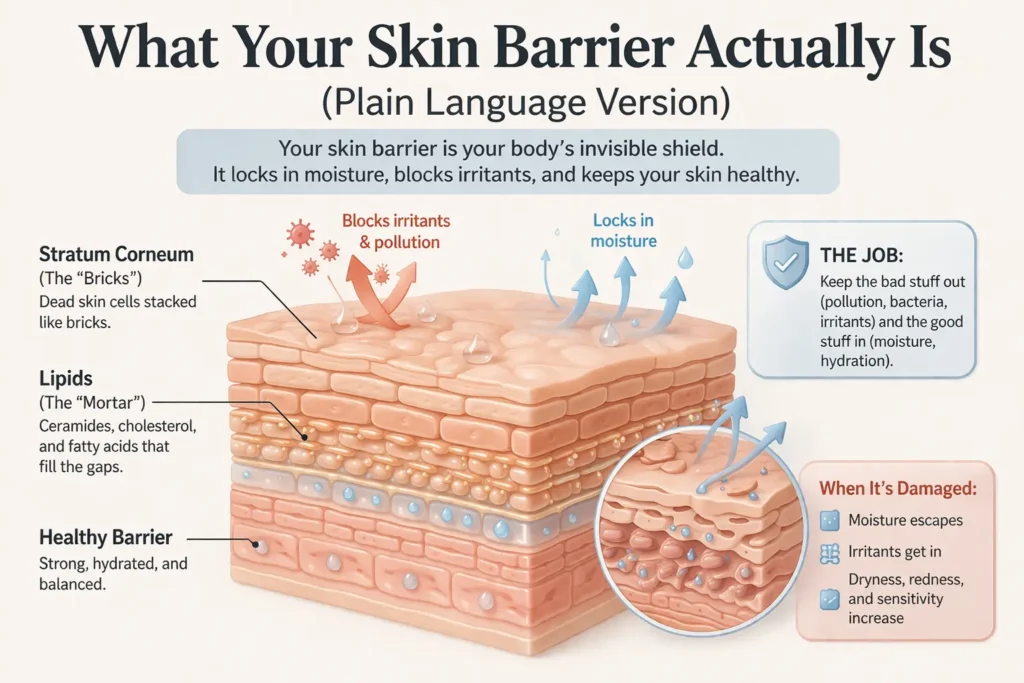
The barrier is made of three things working together:
- Skin cells (the bricks): tough, dead cells called corneocytes that form the structure.
- Lipids (the mortar): natural fats including ceramides, cholesterol, and fatty acids that sit between the cells and hold everything together.
- The acid mantle: a slightly acidic film on the surface (pH 4.5 to 5.5) that prevents harmful bacteria from taking hold.
When these three components are intact, your skin looks healthy. When any of them get disrupted, the barrier breaks. Moisture leaks out. Irritants get in. And your skin starts reacting to things it never used to.
Dr. Melissa Piliang from Cleveland Clinic describes the skin barrier as ‘your outer layer of the skin, made up of dead cells, lipids, proteins and fats that help protect your skin from the environment.’ The rest of your skin is a living organism. The barrier’s job is to protect it.
Why this matters in 2026: Beauty Independent’s industry report named barrier health the top skincare focus of 2026. Consumers have moved from ‘attack and destroy’ skincare (heavy acids, daily retinol) to ‘nurture and balance.’ The terms ‘post-glass skin’ and skinvestment are now used to describe this shift toward protection over correction.
7 Signs Your Skin Barrier Is Damaged Right Now
You do not need a dermatologist visit to recognize barrier damage. These seven signs tell you everything. If you have three or more, your barrier needs help.
| # | Sign | What it feels like |
|---|---|---|
| 1 | Stinging or burning | Products that never bothered you now sting. Even water can feel uncomfortable. This is the clearest sign. |
| 2 | Tightness after cleansing | Your face feels tight or squeaky after washing. That squeaky feeling is not clean. It means your barrier has been stripped. |
| 3 | Persistent redness | Cheeks or nose stay red for hours or days, not just during a workout. Skin is inflamed and reactive. |
| 4 | Dryness despite moisturizing | You apply moisturizer and your skin still feels dry 30 minutes later. Moisture is escaping faster than you can add it. |
| 5 | Breakouts that will not clear | Tiny clusters of bumps, often itchy, that do not respond to acne treatments. These are often barrier-damage breakouts, not normal acne. |
| 6 | Flaking or rough texture | Visible dry patches or rough texture even in areas that are not normally dry. Skin cells are not shedding properly. |
| 7 | New sensitivity to old products | A serum or cream you have used for months now causes irritation. Your barrier has weakened, so it can no longer handle what it used to. |
New to K-beauty or want to go deeper? Explore our K-beauty step-by-step guides on double cleansing, toners, and serums to build the perfect routine tailored just for you. Dive in and level up your skincare game!
What Actually Causes a Damaged Skin Barrier
The number one cause in 2025 and 2026 is over-exfoliation. The skin barrier health conversation exploded online partly because millions of people damaged their barriers chasing glass skin trends. They used AHAs, BHAs, retinol, and vitamin C every single day, sometimes in the same routine, without giving their skin time to recover.
But there are other causes too, and you need to know all of them to avoid making things worse:
| Cause | How it damages the barrier |
|---|---|
| Over-exfoliation | AHAs, BHAs, retinol, and vitamin C used too often strip the lipid layer before it can rebuild. |
| High-pH cleansers | Soaps and foaming cleansers with a high pH disrupt the acid mantle, making the barrier more vulnerable. |
| Hot water | Hot showers and face washing dissolve the skin’s natural oils faster than lukewarm water. |
| Environmental stress | Cold weather, wind, indoor heating, pollution, and UV exposure all erode barrier lipids over time. |
| Fragrance in skincare | Synthetic fragrances and essential oils are leading contact allergens. They trigger inflammation and break down barrier function. |
| Stress and poor sleep | Cortisol, the stress hormone, suppresses the skin’s natural repair mechanisms. Skin barrier lipids rebuild mainly during sleep. |
| Skin conditions | Eczema, psoriasis, and rosacea are often rooted in barrier dysfunction. They create a cycle where damage causes flares that cause more damage. |
Dermatologist perspective: ‘A damaged skin barrier makes it difficult to repair signs of aging and post-breakout marks,’ explains Paula’s Choice skincare. Once the barrier is compromised, almost nothing in your routine works properly because the products cannot penetrate correctly and actives become irritants instead of treatments.
Real Experience: What Barrier Damage Looks and Feels Like
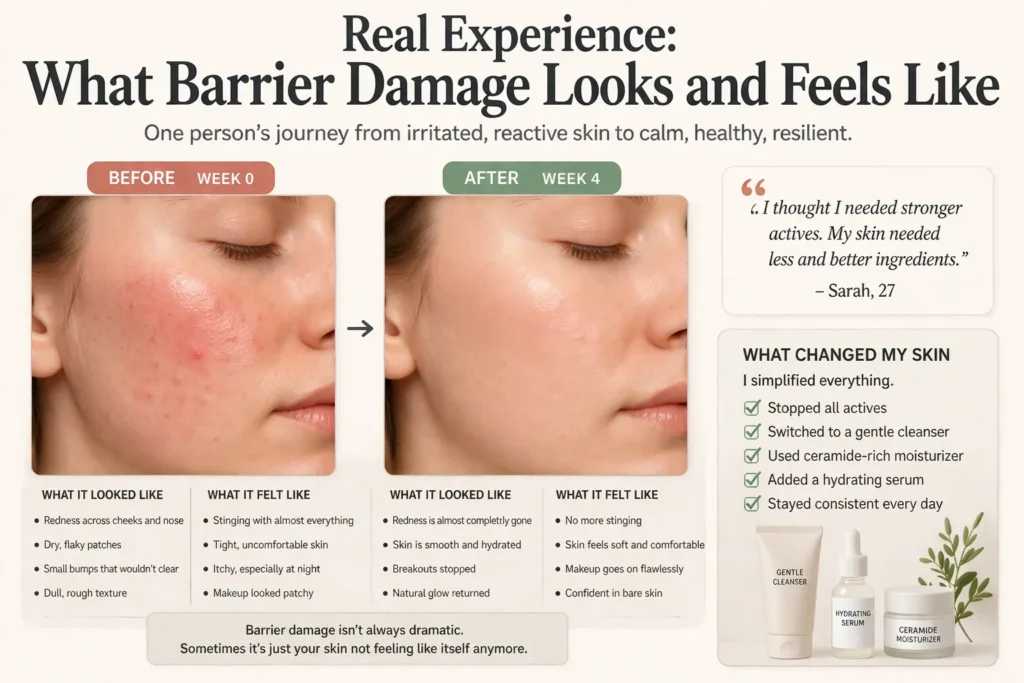
This section is worth reading even if you are not sure whether your skin barrier is damaged. A lot of people chase treatments for ‘acne’ or ‘sensitivity’ when the real problem is that their barrier broke down first.
Here is what barrier damage typically looks like in real life:
Before repair (common experience):
Woke up every morning with skin that felt tight before even washing it. Applied my usual vitamin C serum and it burned on contact. Switched to my hyaluronic acid serum instead, still felt a slight sting. Put on moisturizer and within 20 minutes my skin felt dry again. My cheeks were permanently pink. I had two tiny bumpy patches near my chin that looked like acne but did not respond to any acne products. Foundation was sitting in dry patches and looking rough by midday. I had no idea my barrier was broken. I thought my skin was just becoming more sensitive with age.
After 4 weeks of barrier repair (typical recovery result):
Stopped all exfoliants and vitamin C. Used only a gentle gel cleanser, COSRX Balancium Ceramide Cream, and SPF in the morning. Added CeraVe Moisturizing Cream at night. The stinging stopped within 4 days. Redness reduced noticeably by week 2. By week 3, the small bumpy patches were gone. By week 4, skin felt genuinely calm and balanced for the first time in months. Was able to reintroduce niacinamide at week 5 with no reaction.
This timeline lines up with what dermatologists report. Mild barrier damage improves in 3 to 5 days. Moderate damage, which is the most common type from over-exfoliation, takes 2 to 4 weeks. Severe damage from things like chemical peels or aggressive retinoid use can take 4 to 6 weeks.
The most important part of that experience above is what stopped. No acids. No vitamin C. No retinol. No fragrance. The barrier cannot repair itself while it is still being attacked.
Looking for an Affordable Skincare Routine that fits your budget? We’ve got tips for creating a hydration-focused routine without the hefty price tag!
The Exact Barrier Repair Routine (What to Do and What to Stop)
The principle for barrier repair is this: less is more, and gentler is faster. This is the hardest thing for skincare enthusiasts to accept because the instinct is always to add something. Barrier repair works the other way.
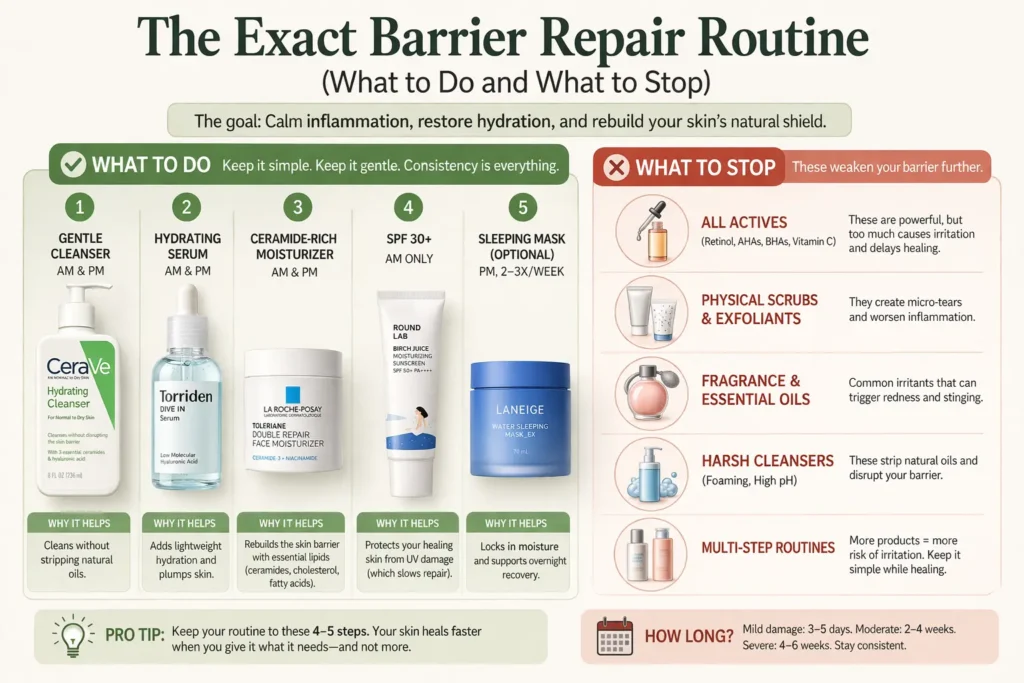
Stop these immediately:
AHAs (glycolic acid, lactic acid), BHAs (salicylic acid), retinol and retinoids, benzoyl peroxide, vitamin C (ascorbic acid above 5%), physical scrubs and exfoliant brushes, fragrance-heavy products and essential oil-based skincare, alcohol-based toners and astringents, hot water on your face
Morning Routine During Repair
- Rinse with lukewarm water only, or use a gentle gel cleanser. Skip double cleansing in the morning.
- Apply a ceramide serum or essence to damp skin. Pat gently. Do not rub.
- Follow with a ceramide moisturizer. Look for ceramide NP, AP, and EOP together in the ingredient list.
- Apply SPF 30 or higher as your final step. UV exposure damages the barrier every day, even indoors.
Evening Routine During Repair
- Double cleanse only if you wore SPF or makeup. Oil cleanser first, gentle gel cleanser second.
- Apply a niacinamide serum to damp skin. Niacinamide boosts ceramide production within the skin itself and is one of the safest actives to use during repair.
- Use a heavier ceramide cream as your moisturizer. More moisture at night supports the natural repair process that happens while you sleep.
- Optional for very dry or severely damaged skin: apply a thin layer of Vaseline (100% petrolatum) over your cream on the driest areas. This is called slugging and it creates an occlusive seal that locks hydration in overnight.
When to reintroduce actives:
Wait at least 3 full weeks before trying any active ingredient. Even if your skin feels fine after a few days, the deeper layers are still healing. Start with niacinamide first (it is the most compatible active during repair). After 2 more weeks, add a very low-strength AHA once per week. Build from there. Never jump back to daily exfoliation.
Best Products for Skin Barrier Repair in 2026
These products are organized by step. Every one of them is available in the US at major retailers. Prices are as of April 2026.
Cleansers
CeraVe Hydrating Cleanser ~$14 at CVS, Target, Walgreens
- Who it’s for: All skin types during barrier repair. Great for dry, normal, and sensitive skin.
- Why it works: Non-foaming, pH-balanced formula with three ceramides and hyaluronic acid. Cleans without stripping the acid mantle. The National Eczema Association recommends it.
- Key ingredient: Ceramides NP, AP, EOP + hyaluronic acid. No fragrance, no sulfates.
- Where to buy: CVS, Walgreens, Target, Amazon
La Roche-Posay Toleriane Hydrating Gentle Cleanser ~$15 at CVS, Target
- Who it’s for: Sensitive and reactive skin. Also works for rosacea-prone skin during a flare.
- Why it works: Extremely gentle. Uses prebiotic thermal water alongside ceramides and niacinamide. Leaves no tight or stripped feeling after use.
- Key ingredient: Niacinamide + ceramides + prebiotic thermal water. Fragrance-free.
- Where to buy: CVS, Target, Ulta
Serums and Essences
COSRX Advanced Snail 96 Mucin Power Essence ~$22 at Ulta, Amazon, Target
- Who it’s for: Damaged, irritated, or post-procedure skin. Works for all skin types, including oily and acne-prone.
- Why it works: 96% snail secretion filtrate provides intense hydration, reduces redness, and supports skin repair at a cellular level. Snail mucin naturally contains glycoproteins and hyaluronic acid. Results are visible in 1 to 2 weeks.
- Key ingredient: 96% snail secretion filtrate (glycoproteins, allantoin, hyaluronic acid). Lightweight, absorbs fast.
- Where to buy: Ulta, Amazon, Target
The Inkey List Peptide Moisturizer ~$13 at Sephora, Ulta
- Who it’s for: Anyone whose barrier damage is linked to thin or aging skin. Peptides signal the skin to produce more collagen, supporting longer-term barrier strength.
- Why it works: Combines peptides with ceramides and hyaluronic acid for barrier repair and texture improvement together. Works well layered under a heavier cream.
- Key ingredient: Matrixyl 3000 peptide complex + ceramides + niacinamide. Budget-friendly.
- Where to buy: Sephora, Ulta, Amazon
Moisturizers (the most important step)
CeraVe Moisturizing Cream ~$18 for 16oz at CVS, Walgreens
- Who it’s for: All skin types. The safest starting point for anyone with barrier damage. Works on face and body.
- Why it works: Ceramide trio (NP, AP, EOP) with hyaluronic acid in CeraVe’s patented MVE technology that releases ceramides gradually over 24 hours rather than all at once. Over 140,000 global reviews at 4.7 stars. The most widely dermatologist-recommended barrier cream in the US.
- Key ingredient: Three-ceramide complex + cholesterol + hyaluronic acid + phytosphingosine. No fragrance.
- Where to buy: CVS, Walgreens, Target, Amazon
If are you thinking to buy products, explore now what’s the Best K-Beauty Brands Available in the US Right Now (2026), read full blog now.
Dr. Jart+ Ceramidin Skin Barrier Moisturizing Cream ~$48 at Sephora
- Who it’s for: Dry, sensitive, and post-procedure skin. Works well under makeup without pilling.
- Why it works: Five ceramide types in a cushiony cream that absorbs faster than its texture suggests. Clinically proven to strengthen barrier after 4 weeks and provide 100 hours of moisture after one use. Dr. Jart+ ran clinical testing on 31 women with 98% reporting skin felt smooth and 94% reporting skin looked healthy after use.
- Key ingredient: 5-Cera Complex (five ceramide types) + panthenol + bifida ferment lysate. Fragrance-free.
- Where to buy: Sephora (exclusive US retailer)
COSRX Balancium Comfort Ceramide Cream ~$22 at Ulta, Amazon
- Who it’s for: Oily or combination skin with barrier damage. Provides ceramide repair without the heavy texture that breaks out oily skin.
- Why it works: Lighter than CeraVe Moisturizing Cream but still packs ceramide NP, centella asiatica, and sunflower seed oil for lipid replenishment. Dries down to a matte finish, not greasy. Works well under makeup.
- Key ingredient: Ceramide NP + centella asiatica + sunflower seed oil (vitamin E). Niacinamide in formula.
- Where to buy: Ulta, Amazon
Torriden Dive-In Low Molecular Hyaluronic Acid Serum (used as a moisture booster) ~$22 at Amazon, Ulta
- Who it’s for: Dehydrated skin during barrier repair. Use before your ceramide cream to flood skin with hydration first.
- Why it works: Five molecular weights of hyaluronic acid work at every skin layer simultaneously, from deep hydration to surface plumping. A single product provides the layered hydration effect that usually takes three products. Fragrance-free, very low irritation risk.
- Key ingredient: 5-molecular-weight hyaluronic acid complex. Fragrance-free, alcohol-free.
- Where to buy: Amazon, Ulta
SPF (non-negotiable during repair)
La Roche-Posay Anthelios Melt-In Milk SPF 60 ~$22 at CVS, Target
- Who it’s for: All skin types during barrier repair. Gentle enough for compromised skin.
- Why it works: Dermatologist-recommended daily SPF. Provides broad-spectrum protection without fragrance or oxybenzone. The melt-in texture feels comfortable on sensitive skin. UV exposure is one of the main ongoing causes of barrier damage, so this step is mandatory every morning.
- Key ingredient: Mexoryl SX and XL UV filters + antioxidants. Fragrance-free, non-comedogenic.
- Where to buy: CVS, Target, Walgreens
This comfort-first approach mirrors what we’ve explored in Morning Skincare Routines That Support Skin Balance, where consistency matters more than complexity.
Which Product Is Right for Your Skin Type?
Use this table to find your exact starting point. You do not need every product above. Pick one cleanser, one serum, one moisturizer, and one SPF, and stick to them for at least three weeks before changing anything.
| Skin type | Best moisturizer | Best serum/booster |
|---|---|---|
| Dry or very dry | CeraVe Moisturizing Cream | COSRX Snail 96 Essence, then Torriden Dive-In HA Serum before the cream. The HA serum plus ceramide cream together rebuild faster for dry types. |
| Oily or acne-prone | COSRX Balancium Ceramide Cream | The Inkey List Niacinamide Serum. Niacinamide rebuilds ceramides while controlling oil. Crucial: a lightweight ceramide cream still needed. Do not skip moisturizer. |
| Sensitive or reactive | CeraVe Moisturizing Cream or Dr. Jart+ Ceramidin | COSRX Snail 96 Essence only. One product, zero risk. Add nothing else until your barrier is stable. |
| Combination | COSRX Balancium all over, CeraVe Moisturizing Cream on dry patches only | Torriden HA Serum on dry areas first. Niacinamide serum all over to balance oilier zones. |
| Post-procedure or severely damaged | Dr. Jart+ Ceramidin. Add thin layer of Vaseline over it at night on the worst areas. | Nothing for the first week. Week 2: COSRX Snail Essence only. Week 3: add a gentle niacinamide serum. |
Quick Comparison: Best Pick by Concern
| Your main concern | Best product to reach for |
|---|---|
| Best overall barrier repair | CeraVe Moisturizing Cream. Widely available, affordable, clinically validated ceramide complex. |
| Best for oily or acne-prone barrier damage | COSRX Balancium Ceramide Cream. Provides ceramides without heavy texture. Pairs with niacinamide for barrier rebuild and oil control. |
| Best K-beauty barrier repair | Dr. Jart+ Ceramidin. Five ceramide types, clinically tested, loved by dermatologists and K-beauty enthusiasts equally. |
| Best for sensitive or reactive skin | La Roche-Posay Toleriane Cleanser + CeraVe Moisturizing Cream. Both are fragrance-free and recommended for eczema-prone skin. |
| Best budget option | CeraVe Moisturizing Cream (~$18 for 16oz) or COSRX Balancium (~$22). Both outperform products costing three times more. |
| Best for repairing while still fighting acne | COSRX Snail 96 Essence + niacinamide serum. Snail mucin repairs. Niacinamide builds ceramides and reduces inflammation. |
Lifestyle Habits That Speed Up Barrier Recovery
Products do most of the work, but these habits make a real difference in how fast your barrier heals. Think of them as the environment your skin repairs itself in.
- Drink 2 to 3 liters of water per day. Your skin is the last organ to receive water from what you drink. Systemic hydration supports every layer of barrier function. You will notice a visible difference in plumpness within a week.
- Sleep 7 to 9 hours. Skin barrier lipids rebuild mainly at night. Chronic sleep deprivation directly reduces ceramide production and slows repair. This is not optional.
- Use a humidifier if you live in a dry climate or use air conditioning. Dry air pulls moisture from your skin. A humidifier keeps environmental humidity between 40 and 60%, which noticeably reduces how hard your barrier has to work.
- Eat omega-3 fatty acids. Salmon, walnuts, flaxseeds, and chia seeds provide the fatty acids your body uses to build skin barrier lipids. Studies show omega-3 supplementation improves skin hydration and reduces inflammation.
- Reduce sugar intake. High sugar consumption triggers glycation, a process that stiffens skin proteins and disrupts barrier lipid production. Cutting refined sugar is one of the dietary changes that shows up fastest in skin texture.
- Manage cortisol. Stress directly suppresses barrier repair mechanisms. Even 10 minutes of daily movement, breathing exercises, or time away from screens reduces cortisol enough to improve skin recovery speed.
- Change your pillowcase every 2 to 3 days. Fabric absorbs your ceramide cream overnight and transfers bacteria back onto damaged skin. Silk or satin pillowcases are gentler on a compromised barrier.
want to know about What Is Glass Skin? How to Get It With Drugstore Products (2026), just read full blog now.
Why Skin Barrier Health Is the Biggest Skincare Story of 2026

This is not a niche skincare interest anymore. Barrier health has moved into the mainstream.
The global skincare market is valued at $215.4 billion in 2026, and barrier repair products are among the fastest-growing segments within it, according to Future Market Insights. Searches for barrier-supportive ingredients grew 51% year over year in 2025. Beta-glucan became the trending barrier hero ingredient of 2026, with searches surging according to Glimpse’s consumer trend data.
Beauty Independent’s 2026 skincare industry report summed it up directly: ‘People are finally waking up to the fact that regeneration cannot happen on a chronically irritated canvas. Barrier-supportive formulations, postbiotic blends and lipid-balanced vehicles are becoming essential.’
Boots’ 2026 Beauty and Wellness Trends Report found that 80% of adults are taking a preventative approach to their beauty routines, focused on long-term care rather than quick fixes. Forty-seven percent now change their routine specifically because of environmental factors and flares. That is a massive shift from the aggressive, results-at-any-cost approach of the early 2020s.
The K-beauty industry drove a lot of this shift. Korean skincare has always centered on barrier health rather than stripping. Brands like COSRX, Dr. Jart+, and Torriden built their entire product lines around ceramides, snail mucin, centella asiatica, and gentle hydration. The US market has absorbed this approach and it is reshaping what American consumers expect from skincare entirely.
Frequently Asked Questions
How long does it take to repair a damaged skin barrier?
Mild barrier damage, from a one-off harsh product or weather exposure, heals in 3 to 5 days with the right routine. Moderate damage from sustained over-exfoliation or regular retinol use takes 2 to 4 weeks. Severe damage from chemical peels, strong prescription retinoids, or prolonged misuse of actives can take 4 to 6 weeks to fully stabilize. The key factor is stopping all actives immediately and giving your skin a genuinely simple routine during recovery.
Can I still use niacinamide when my barrier is damaged?
Yes, niacinamide is one of the safest actives to use during barrier repair. It directly stimulates ceramide production within the skin, reduces redness, and strengthens the barrier rather than irritating it. Use 5% niacinamide, not higher concentrations during repair. Avoid combining it with pure ascorbic acid vitamin C serums until your barrier is stable, as this combination can cause flushing in some people.
Is my oily skin causing breakouts because my barrier is damaged?
Yes, damaged barriers cause breakouts in oily skin very commonly. When the barrier breaks down, oily skin compensates by producing more sebum, which clogs pores. The barrier damage also lets in bacteria more easily, triggering inflammation. Moisturizing with a lightweight ceramide cream (COSRX Balancium or CeraVe PM Lotion) reduces this compensation cycle. The counterintuitive truth is that adding more moisture to oily, damaged skin reduces breakouts over time.
What is the difference between dehydrated skin and a damaged skin barrier?
Dehydrated skin lacks water. A damaged skin barrier leaks water. They feel similar (tight, dull, rough) but need different approaches. Dehydration is fixed with hyaluronic acid and drinking more water. Barrier damage needs ceramides and lipid replenishment. You can have both at the same time, which is common. Use a hyaluronic acid serum first on damp skin, then seal it with a ceramide cream to address both simultaneously.
Can makeup damage my skin barrier?
Some makeup products do contribute to barrier damage. Silicone-heavy foundations and primers can sometimes clog pores in barrier-damaged skin. Waterproof makeup requires more aggressive removal, which can strip lipids. Heavily fragranced products are the biggest culprit. During barrier repair, switch to fragrance-free, minimal-ingredient makeup. Remove it only with a gentle oil cleanser followed by a mild water-based cleanser. Avoid makeup wipes, which drag across the skin and cause micro-tears.
Does slugging (applying Vaseline as the final step) actually help?
Yes, for severely damaged or very dry skin. Petrolatum (100% Vaseline) is one of the most effective occlusive ingredients in existence. It creates a physical barrier that prevents water from evaporating from your skin overnight. It does not block pores because its molecules are too large to penetrate. Apply a thin layer over your ceramide moisturizer on the driest or most damaged areas at night. Not everyone needs this step. It is most useful during active barrier crisis, particularly in cold or dry environments.
Can I use sheet masks to repair my barrier faster?
Sheet masks can help, but choose carefully. During barrier damage, the only sheet masks appropriate are those containing ceramides, hyaluronic acid, centella asiatica, or beta-glucan. Avoid any mask with fragrance, AHA, BHA, vitamin C, retinol, or brightening actives. A well-chosen sheet mask two to three times per week during repair provides an intensive hydration boost. COSRX Ultimate Nourishing Rice Overnight Spa Mask and some Mediheal sheet masks are good options.
How do I know when my barrier is fully repaired?
Your barrier has recovered when: products no longer sting on application, your skin retains moisture for more than a few hours after moisturizing, redness has calmed significantly, texture feels smooth rather than rough, and you no longer have reactive breakout clusters. At that point you can cautiously reintroduce one active ingredient at a time. Start with niacinamide, wait two weeks, then add one chemical exfoliant used once per week. Build back very slowly.
Related Reading on GlobleVide
- K-Beauty Skincare Routine for Beginners: Your Complete US Guide (2026)
- What Is Glass Skin? How to Get It With Drugstore Products (2026)
- Best K-Beauty Brands Available in the US Right Now (2026)
- Double Cleansing Method: Does It Actually Work for Oily Skin? (2026)
Sources
Healthline. (2025). What to Know About Your Skin Barrier and How to Protect It. Updated July 29, 2025.
Cleveland Clinic, Dr. Melissa Piliang. (2022). How to Tell If Your Skin Barrier Is Damaged. health.clevelandclinic.org
Future Market Insights. (2026). Skincare Market Forecast and Outlook 2026 to 2036. futuremarketinsights.com
Cosmetics Business / Beauty Independent. (2026). Top Skincare Trends for 2026. beautyindependent.com
Glimpse. (2026). Top 33 Skincare Trends of 2026. meetglimpse.com
Legend Age Global. (2026). How to Repair a Damaged Skin Barrier in 4-6 Weeks. legendageglobal.com
Skin Research and Technology. (2015). Transepidermal Water Loss and Barrier. Referenced by Legend Age 2026.
GoodRx. (2025). Skin Barrier Repair: Fix and Fortify Your Skin Barrier. goodrx.com
Who What Wear. (2025). 7 Skincare Trends That Will Define 2026. whowhatwear.com
Dr. Jart+. (2026). Ceramidin Skin Barrier Moisturizing Cream: Clinical Testing Results. drjart.com

Editorial Note: This article follows GlobleVide’s Editorial Policy and Fact-Checking Policy.