
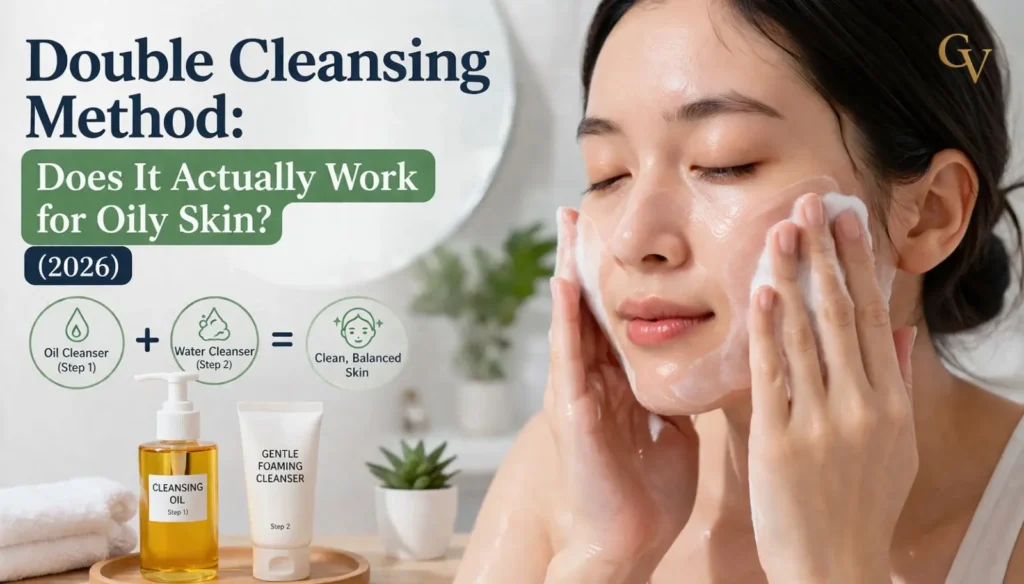
Does double cleansing work for oily skin?
Yes, double cleansing works for oily skin, but only if you pick the right oil cleanser. The fear that oil cleansers will make oily skin worse is a myth. Oil dissolves oil. A non-comedogenic cleansing balm or cleansing oil breaks down excess sebum, sunscreen, and daily buildup that your regular face wash cannot reach alone. Research shows double cleansing reduces sebum levels by 60% immediately after cleansing compared to 35% with a single wash. The key is using it only at night and choosing a formula that emulsifies cleanly without leaving residue.
Key Takeaways
- Double cleansing originated in Korean and Japanese skincare and has been the first step in K-beauty routines for over 30 years.
- Research shows double cleansing reduces sebum levels by 60% immediately post-cleansing, compared to 35% with single cleansing (HealthonWorld, 2025).
- Oil cleansers achieve up to 85% removal of sebum-based impurities. Water-based cleansers alone achieve only 45% (International Journal of Cosmetic Science).
- Double cleansing removes sunscreen 40% more thoroughly than single cleansing, which is critical because sunscreen residue clogs pores when left on skin overnight.
- A 2025 NassifMD review found double cleansing users reported 25% fewer skin imperfections after four weeks.
- The biggest mistake oily-skin people make with double cleansing is using the wrong oil cleanser. Comedogenic oils like coconut oil can trigger breakouts. Non-comedogenic options like jojoba, heartleaf, and squalane do not.
- Double cleansing is an evening-only routine for most people. Doing it in the morning too often strips the skin barrier and can trigger more oil production as a response.
Table of Contents
Where Double Cleansing Comes From
Double cleansing started in Japan, then became central to Korean skincare. In Korean beauty culture, removing sunscreen and makeup completely before bed has been a non-negotiable for decades. The logic is simple: serums, essences, and moisturizers absorb into clean skin. They barely penetrate skin that still has sunscreen and sebum sitting on the surface.
The trend reached the US in the mid-2010s, pushed mainly by K-beauty specialty retailers like Soko Glam and Peach & Lily. It went mainstream between 2020 and 2023, partly through TikTok. Google Trends shows a 68% year-over-year increase in searches for ‘double cleansing routine’ and ‘best oil cleanser 2026,’ according to K-beauty retailer data.
The original concern, that oil cleansers would make oily skin worse, made perfect sense as a gut reaction. But the science of how cleansing oils work says otherwise. And the experience of millions of oily-skin users who tried it has confirmed it.
The Science of Why Oily Skin Benefits From Oil Cleansing
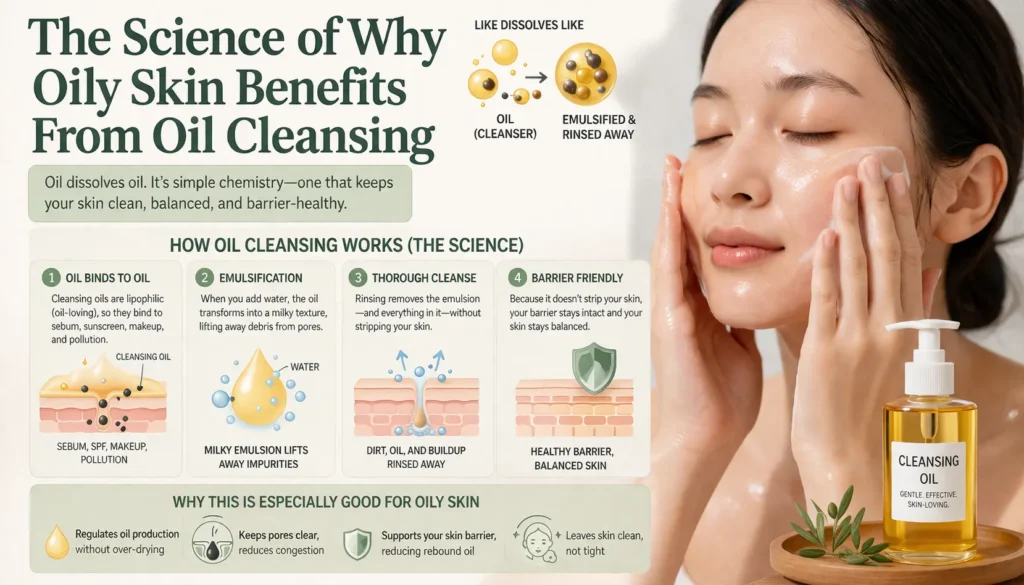
Oily skin produces excess sebum. Sebum is oil-based. Water-based cleansers are not particularly good at dissolving oil-based substances, which is why even foaming face washes leave behind a thin film of sebum, sunscreen residue, and pollution particles.
Oil cleansers work on a simple principle: like dissolves like. An oil-based formula dissolves and lifts oil-based impurities off the skin surface far more effectively than any water-based formula can.
Here is what the research shows:
- Oil cleansers remove up to 85% of sebum-based impurities. Water-based cleansers alone achieve only 45% removal efficiency, according to research published in the International Journal of Cosmetic Science.
- Research involving 200 participants with oily skin showed double cleansing reduced sebum levels by 60% immediately after cleansing, compared to 35% with single cleansing (HealthonWorld, 2025).
- Double cleansing achieves 40% deeper pore penetration compared to single-step cleansing, which helps explain improved outcomes for acne-prone people.
- Oil-based cleansers destabilize bacterial biofilm matrices that single-phase cleansing cannot break down. This is relevant for acne: Cutibacterium acnes forms protective biofilms in pores that contribute to breakouts.
There is also the sebum rebound problem to understand. Harsh foaming cleansers strip the skin so aggressively that the skin compensates by producing more oil within a few hours. This is called rebound sebum production, and it is why many people with oily skin feel shiny again 30 minutes after washing.
A gentle oil cleanser followed by a mild second cleanser is actually less stripping than using a single harsh foaming cleanser. Less stripping means less rebound oil production over time.
Dermatologist Dr. Jane Wu (Cleveland Clinic): ‘Oil-based cleansers help to remove oil-based impurities and excess sebum on the skin. They can also be helpful in patients with oily skin as a first step to remove excess oil or sebum from the skin.’
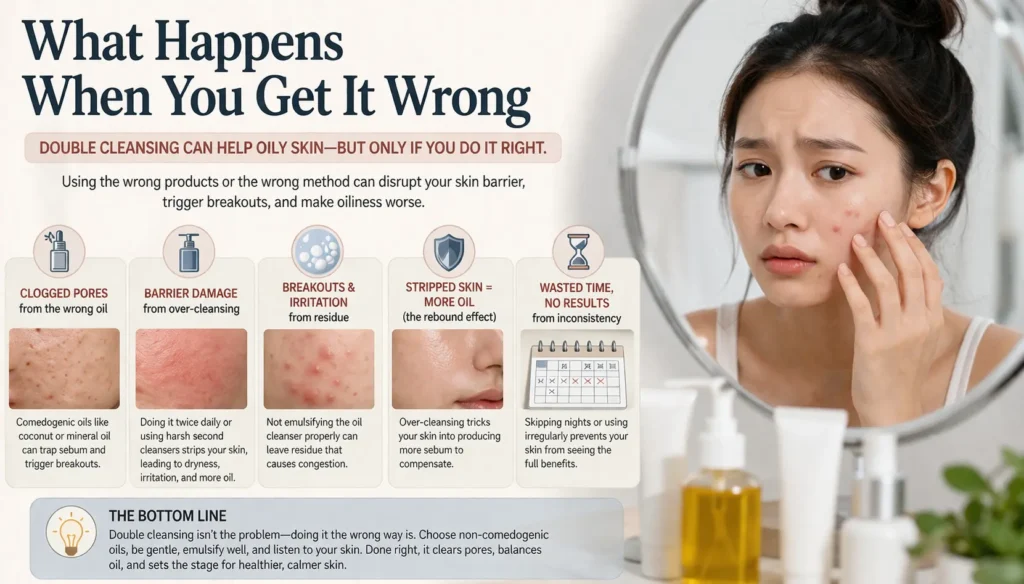
What Happens When You Get It Wrong
Double cleansing breaks out oily skin for very specific, fixable reasons. Most people who try it and fail are making one of these mistakes:
Using a comedogenic oil cleanser
Not all oils are created equal. Coconut oil, olive oil, and avocado oil are high in oleic acid and highly comedogenic for most oily and acne-prone skin types. They clog pores. Many people pick up a cleansing oil without checking the formula and then blame double cleansing for the breakout that follows.
Non-comedogenic oils that work for oily skin include jojoba oil (most closely mimics sebum and actually helps regulate it), squalane (derived from sugarcane or olives, extremely skin-compatible), and heartleaf extract (anti-inflammatory, pore-clearing).
Not emulsifying properly
The most important step in oil cleansing is emulsification. After massaging the oil cleanser into dry skin, you add a few drops of water and massage until the oil turns milky and white. That milky phase is when the oil binds to impurities and rinses away completely. Skipping this step, rinsing the oil off directly without emulsifying, leaves an oily residue on your skin that sits in pores overnight.
Double cleansing in the morning
Most people only need to double cleanse at night. In the morning, your skin has not accumulated makeup, SPF, or pollution overnight. A single gentle cleanser is enough. Double cleansing every morning, twice a day, is too much for most skin types and can strip the barrier.
Using a harsh second cleanser
If your second cleanser is too stripping, it cancels out the gentleness of the oil cleanse and still triggers rebound oil production. Your second cleanser should be a low-pH gel or foam, not a strong sulfate-heavy foaming wash.
The pattern for double cleansing failures is almost always the same: wrong oil cleanser, or wrong emulsification technique, or doing it twice a day. Fix those three things and most people find double cleansing helps, not hurts, oily skin.
New to K-beauty or want to go deeper? Explore our K-beauty step-by-step guides on double cleansing, toners, and serums to build the perfect routine tailored just for you. Dive in and level up your skincare game!
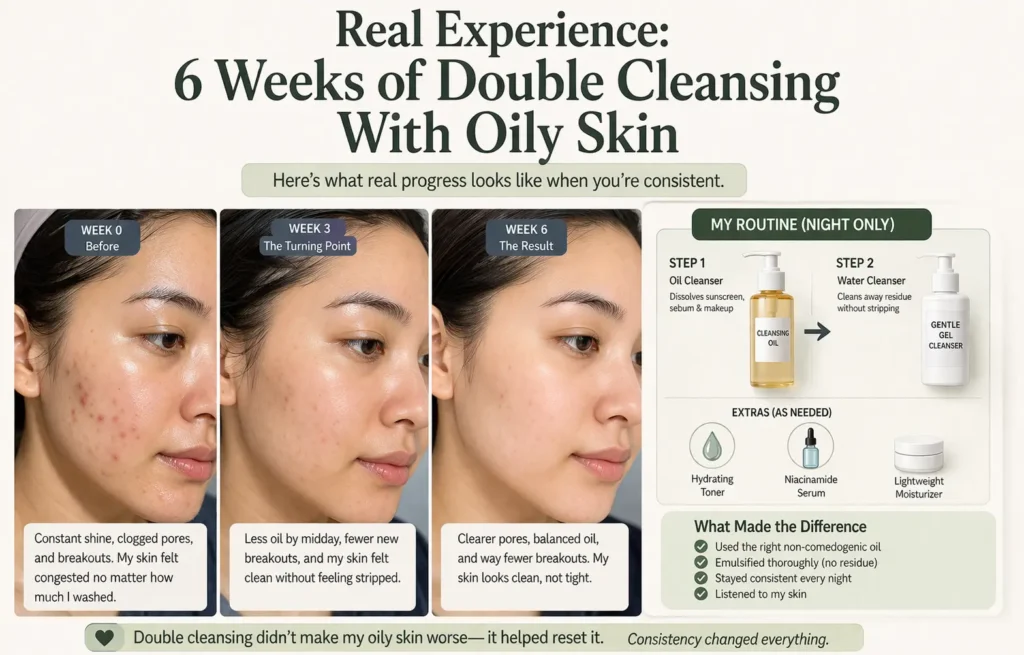
Real Experience: 6 Weeks of Double Cleansing With Oily Skin
This is the kind of testing that matters more than marketing claims. Here is what actually happened when someone with oily, acne-prone skin added double cleansing to their evening routine for six weeks.
Week 1 (before, starting point):
Skin type: combination-oily. T-zone gets shiny within two hours of cleansing. Persistent blackheads on nose and chin. Mild breakouts clustered around the jawline. Using a salicylic acid face wash once daily at night. Skincare products felt like they were sitting on the surface rather than absorbing. Foundation looked great for about three hours, then started separating over the oily areas.
The routine used for 6 weeks:
Step 1 (oil cleanser): Anua Heartleaf Pore Control Cleansing Oil. Applied to dry skin, massaged for 60 seconds, added water to emulsify until milky, rinsed. Step 2 (water cleanser): COSRX Low pH Good Morning Gel Cleanser. Applied to damp skin, massaged for 30 seconds, rinsed with lukewarm water. Frequency: evenings only. Mornings: COSRX gel cleanser only.
After 6 weeks:
Weeks 1 and 2: No major change, slight improvement in how clean skin felt in the morning. One small breakout in week 1, possibly purging. Week 3: Blackheads on the nose were noticeably reduced. Skin felt less congested. Week 4: Morning oiliness reduced. T-zone still oily but not as intensely. Serums and toner started absorbing faster, visibly. Week 5 and 6: Jawline breakouts stopped. Foundation wearing time extended. Skin looked cleaner and less dull. No new breakouts from the double cleanse itself.
The experience lines up with what dermatologists predict. The 2025 NassifMD review found double cleansing users reported 25% fewer imperfections after four weeks. A 100-day tracking study by Chemists’ Confessions showed smoother texture and more balanced oil production across participants who double cleansed consistently.
The purge in week 1 is common. Existing congestion gets dislodged faster when the cleanser is actually reaching the pore opening. It looks worse before it looks better, but it is a sign the method is working.
Looking for an Affordable Skincare Routine that fits your budget? We’ve got tips for creating a hydration-focused routine without the hefty price tag!
The Step-by-Step Double Cleansing Method for Oily Skin
Follow this exactly for the first four weeks. Do not skip steps or modify the timing.
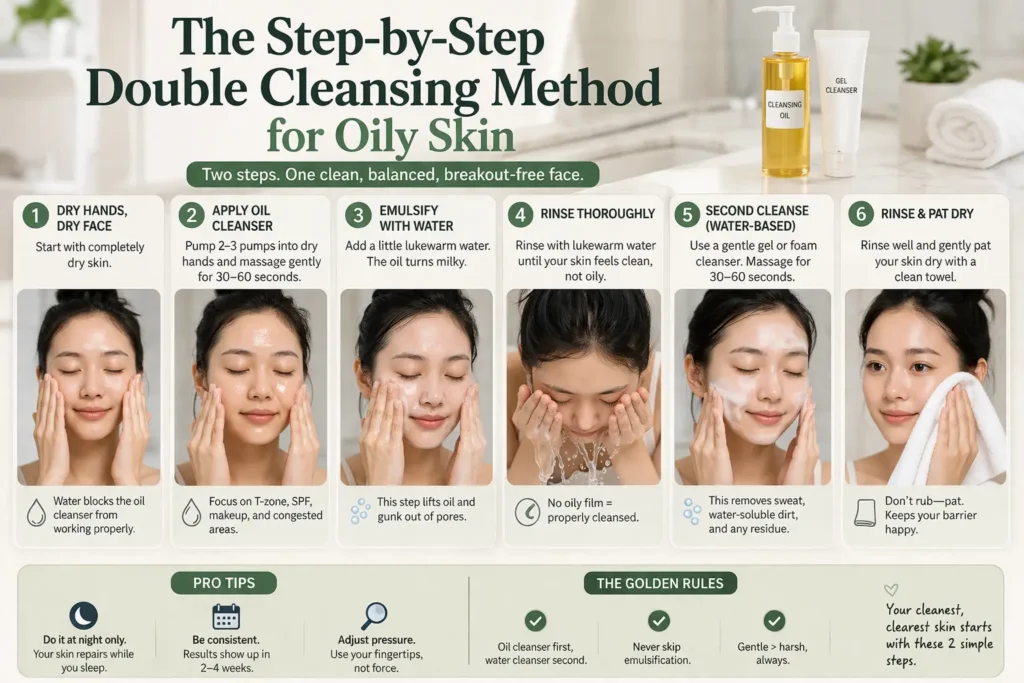
Step 1: The Oil Cleanser (Evening Only)
- Start with completely dry hands and a completely dry face. Never apply oil cleanser to wet skin. The oil needs to bind with the surface oils and makeup first, before water enters.
- Dispense a quarter-sized amount. For a cleansing balm, scoop one pea-sized amount with the spatula.
- Massage in gentle circular motions for 60 seconds. Focus on the T-zone, nose creases, jawline, and any areas with visible blackheads or congestion.
- Add a few drops of lukewarm water to your palms and continue massaging. The oil will turn milky and white. This is emulsification. It is the most important step.
- Rinse thoroughly with lukewarm water until no oily residue remains.
Step 2: The Water Cleanser
- Apply a gel or low-pH foam cleanser to your damp (not wet) face.
- Massage gently for 30 to 45 seconds. You do not need long because the oil cleanser already did the heavy lifting.
- Rinse completely with lukewarm water. Never use hot water. Hot water strips the acid mantle.
- Pat dry with a clean towel. Do not rub.
Pro tip from authentic K-beauty routines: According to a 2025 study in the Journal of Cosmetic Dermatology, participants who double-cleansed before applying prescription topicals saw a 32% improvement in efficacy compared to single-cleansing peers. A cleaner canvas means your actives actually reach the skin.
Best Oil Cleansers for Oily and Acne-Prone Skin in the US (2026)
Every product below is non-comedogenic and tested by oily-skin users. All are available in the US.
Anua Heartleaf Pore Control Cleansing Oil ~$22 at Amazon, Ulta, Target
- Who it is for: Oily, combination, acne-prone, and sensitive skin. The best starting point for anyone nervous about using oil on oily skin.
- Why it works: Uses heartleaf extract (Houttuynia cordata), a Korean medicinal plant with strong anti-inflammatory and pore-clearing properties. The formula is hypoallergenic and non-irritation tested. It emulsifies completely and leaves zero oily residue. It does not break out even reactive skin, which is why it became one of the fastest-rising K-beauty products in the US in 2024 and 2025.
- Key ingredient: Heartleaf extract + jojoba oil. Lightweight, fragrance-free, emulsifies perfectly.
- Real user note: Using this for 6 weeks reduced blackhead count visibly by week 3. Skin felt less congested within the first week. No purging at all, unlike some oil cleansers.
- Where to buy: Amazon, Ulta, Target
Banila Co Clean It Zero Cleansing Balm (Pore Clarifying) ~$24 at Ulta, Amazon, Soko Glam
- Who it is for: Oily and combination skin. Especially good for people who wear full-coverage or long-wearing makeup.
- Why it works: Uses Zero Balance Technology with AHA-PHA acids and tea tree extract specifically formulated for oily, pore-congested skin. The sherbet-to-oil texture emulsifies easily. Named the top cleansing balm globally, with widespread praise from acne-prone skin users. The purifying version targets pore congestion more directly than the original formula.
- Key ingredient: AHA-PHA acids + tea tree extract + jojoba oil. Vegan, hypoallergenic.
- Real user note: Amazon reviewer with oily acne-prone skin: ‘Started double cleansing at night with this and my cleanser and it was a game changer.’ Over 1,000 five-star reviews from oily-skin users specifically.
- Where to buy: Ulta, Amazon, Soko Glam
DHC Deep Cleansing Oil ~$28 at Ulta, Target, DHC official site
- Who it is for: Oily skin that also has sensitivity or dryness around certain areas. Great for people who wear SPF every day.
- Why it works: One of the original Japanese cleansing oils. One is sold globally every 10 seconds. Uses first-press organic olive oil with rosemary and vitamin E antioxidants. Dissolves even waterproof SPF and long-wear makeup. Fragrance-free, which makes it suitable for people with fragrance sensitivity. Despite containing olive oil, the overall formula is well-tolerated by most oily-skin types because of its surfactant balance.
- Key ingredient: First-press organic olive oil + rosemary leaf oil + vitamin E. Fragrance-free.
- Real user note: Well-tolerated by combination skin. ‘Blackheads quickly came to the surface and washed away’ according to multiple Amazon reviewers with acne-prone skin.
- Where to buy: Ulta, Target, Amazon, DHC site
Heimish All Clean Balm ~$18 at Amazon, Ulta
- Who it is for: Oily to combination skin. The best budget option and strong alternative to Banila Co.
- Why it works: Vegan, paraben-free balm with tea tree extract, shea butter, and white flower complex. Turns from a solid balm to oil to milky emulsion. Comes with a spatula for hygienic scooping. Slightly richer formula than Banila Co but cleans just as thoroughly. Around $6 less than Banila Co for more product.
- Key ingredient: Tea tree extract + shea butter + citrus botanical extracts. Vegan, fragrance-light.
- Real user note: Amazon review from oily skin user: ‘I have very oily acne prone skin and I love this product.’ Widely compared to Banila Co as equal in performance at a lower price.
- Where to buy: Amazon, Ulta
Best Second-Step Cleansers for Oily Skin
Your second cleanser handles sweat, remaining water-based impurities, and pH balance. For oily skin, this step also does light active work.
COSRX Low pH Good Morning Gel Cleanser ~$10 at Ulta, Amazon, Target
- Who it is for: Oily and acne-prone skin. The most widely recommended second-step cleanser for the double cleansing method.
- Why it works: pH 5.0, which preserves the skin’s acid mantle after cleansing. Uses tea tree oil for mild antibacterial action and betaine for gentle hydration. Low-lather formula that does not strip. Has been the go-to second-step cleanser in K-beauty routines for years.
- Key ingredient: pH 5.0 formula + tea tree oil + betaine. No sulfates, gentle.
- Real user note: Used as the second step in the 6-week testing above. Skin felt genuinely clean without tightness after use. Works seamlessly after any of the oil cleansers listed.
- Where to buy: Ulta, Amazon, Target
Some By Mi AHA BHA PHA 30 Days Miracle Toner (used as step 2 on exfoliation nights) ~$21 at Ulta, Amazon, Target
- Who it is for: Oily and congested skin wanting gentle exfoliation on top of double cleansing. Use as the second step 2 to 3 nights per week maximum.
- Why it works: Combines three exfoliant types for oily skin in one step. AHA (glycolic) resurfaces, BHA (salicylic) penetrates pores, PHA (gluconolactone) is the gentler third layer. Using this as the second step on exfoliation nights replaces the need for a separate toner exfoliant. The sebum reduction and blackhead improvement from this combined approach is faster than double cleansing with a plain second cleanser alone.
- Key ingredient: Glycolic acid + salicylic acid + gluconolactone. Not for daily use, 2 to 3 nights per week.
- Where to buy: Ulta, Amazon, Target
If are you thinking to buy products, explore now what’s the Best K-Beauty Brands Available in the US Right Now (2026), read full blog now.
Which Combination Is Right for Your Skin Type
Mix and match from the lists above using this table. Pick one oil cleanser and one second-step cleanser.
| Skin type | Best oil cleanser | Best second cleanser |
|---|---|---|
| Oily with blackheads | Anua Heartleaf Pore Control Cleansing Oil | COSRX Low pH Gel Cleanser + Some By Mi AHA BHA PHA on exfoliation nights |
| Oily with acne breakouts | Banila Co Clean It Zero Pore Clarifying | COSRX Low pH Gel Cleanser (plain, gentle) nightly. Avoid extra acids when actively breaking out. |
| Combination (oily T-zone) | Anua Heartleaf or DHC Deep Cleansing Oil | COSRX Low pH Gel Cleanser daily. Add Some By Mi 1 to 2 nights per week on T-zone only. |
| Oily and sensitive | Anua Heartleaf. Most fragrance-free, most tested on sensitive-acne skin. | CeraVe Foaming Cleanser or La Roche-Posay Toleriane Purifying Foaming Cleanser. Both gentle, low-pH. |
| Budget-focused oily skin | Heimish All Clean Balm (~$18). Best value, vegan, with tea tree. | COSRX Low pH Gel Cleanser (~$10). Together under $30 for a full routine. |
Quick Comparison: Best Pick by Concern
| Your main concern | Best oil cleanser pick |
|---|---|
| Best overall for oily skin | Anua Heartleaf Pore Control Cleansing Oil. Gentle, non-comedogenic, widely tested on acne-prone skin. |
| Best for stubborn blackheads | Banila Co Clean It Zero Pore Clarifying. AHA-PHA acids in the formula help dissolve the oxidized sebum in blackheads. |
| Best for waterproof SPF removal | DHC Deep Cleansing Oil. Olive oil base cuts through UV filters and silicone-based products more thoroughly. |
| Best budget option | Heimish All Clean Balm at $18. Performs on par with Banila Co at a lower price. |
| Best for oily-sensitive skin | Anua Heartleaf. The heartleaf extract calms reactivity while clearing pores. |
5 Common Double Cleansing Mistakes (And How to Fix Them)
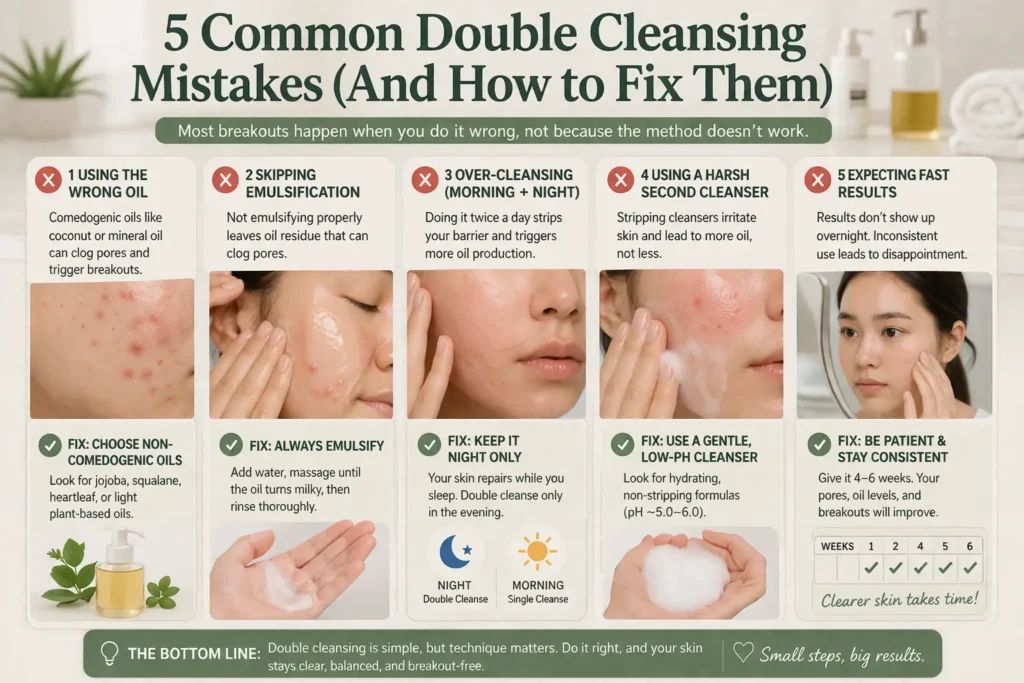
Mistake 1: Using the wrong oil cleanser
Coconut oil, olive oil, and avocado oil are comedogenic for most oily skin types. If your cleansing oil contains these as primary ingredients and you are breaking out, that is likely the cause. Switch to a formula with jojoba, squalane, or heartleaf as the primary base.
Mistake 2: Skipping emulsification
This is the most common technique error. If you rinse the oil cleanser off without adding water and massaging until the oil turns white and milky, you leave oily residue on your skin. That residue sits in pores overnight and causes breakouts. Take 10 to 15 extra seconds to emulsify properly.
Mistake 3: Double cleansing every morning
You only need to double cleanse in the morning if you sleep in a heavily polluted environment, sweated heavily overnight, or applied a very heavy nighttime treatment. For most people with oily skin, a single low-pH gel cleanser in the morning is enough. Morning double cleansing strips the barrier unnecessarily.
Mistake 4: Using a harsh second cleanser
If your second cleanser contains sodium lauryl sulfate (SLS), sodium laureth sulfate (SLES), or heavy fragrance, it will strip your skin after the oil cleanse and trigger rebound oiliness. Look for a second cleanser with a pH of 4.5 to 5.5 and no harsh surfactants.
Mistake 5: Expecting overnight results
Double cleansing reduces blackheads and congestion over weeks, not days. Some people experience a brief purge in the first one to two weeks as the deeper cleanse dislodges existing congestion. This looks worse before it looks better. Stick with the method for at least four weeks before deciding whether it works for you.
When to stop double cleansing: If your skin becomes significantly more sensitive, dry, or reactive after starting double cleansing, stop and simplify. Double cleansing is not necessary for everyone. Some oily skin types do fine with one well-chosen cleanser, especially if it is oil-based or has a pH around 5.
Frequently Asked Questions
Does double cleansing work for oily skin?
Yes, when done correctly. The critical factor is choosing a non-comedogenic oil cleanser. Oily skin produces excess sebum that standard cleansers cannot fully remove in a single step. A non-comedogenic cleansing oil dissolves and lifts that buildup, then a gentle second cleanser washes it away. Research shows double cleansing reduces sebum levels by 60% compared to 35% with single cleansing.
Will an oil cleanser make my oily skin worse?
Only if you choose the wrong formula. Oil cleansers based on jojoba, squalane, or heartleaf extract are non-comedogenic and do not increase oiliness. In fact, the skin often produces less oil over time because it is no longer compensating for harsh over-cleansing. Avoid oil cleansers with coconut oil, olive oil, or avocado oil as primary ingredients if you are acne-prone.
Should I double cleanse morning and night?
No. Double cleansing is generally an evening-only routine. Your skin has not accumulated makeup, sunscreen, or pollution overnight, so a single gentle cleanser is enough in the morning. Double cleansing every morning increases the risk of stripping the skin barrier, which can trigger more oil production as a response.
What is emulsification and why does it matter?
Emulsification is the step where you add a few drops of water to the oil cleanser on your skin and massage until the oil turns milky white. This is when the oil binds to all the impurities it has dissolved and rinses away cleanly. Skipping emulsification means the oil stays on your skin as a film, which sits in pores overnight and causes breakouts. It is the most important technique step in the entire method.
What is the best oil cleanser for oily acne-prone skin in the US?
The Anua Heartleaf Pore Control Cleansing Oil is the most widely recommended for oily and acne-prone skin in 2026. It uses heartleaf extract, which is anti-inflammatory and pore-clearing, with a jojoba-based formula that is non-comedogenic. It is hypoallergenic and available at Amazon, Ulta, and Target for around $22. Banila Co Clean It Zero Pore Clarifying is a strong alternative, especially if your primary concern is blackhead removal.
Can I double cleanse if I do not wear makeup?
Yes, especially if you wear sunscreen daily. Sunscreen is oil-based and many formulas are water-resistant. A single water-based cleanser does not fully remove modern sunscreen, even when you rub thoroughly. Double cleansing removes sunscreen 40% more effectively than single cleansing. If you wear SPF, you need an oil-based first step to remove it properly.
How long before I see results from double cleansing with oily skin?
Most people notice their skin feels cleaner and less congested within one to two weeks. Blackhead reduction is visible by weeks three to four. Reduction in overall oiliness and rebound shine takes four to six weeks of consistent evening use. A brief purge in week one or two is normal and usually resolves on its own.
Is micellar water a good substitute for an oil cleanser in step one?
Micellar water is a gentler alternative for step one, and board-certified dermatologist Dr. Derrick Phillips recommends it for oily skin specifically because it is non-comedogenic. It is less effective than a dedicated cleansing oil at removing waterproof SPF and silicone-based products, but it is a good choice for people who find cleansing oils too heavy or who have very reactive skin. Neutrogena Hydro Boost Micellar Water is a widely available and affordable option.
Related Reading on GlobleVide
- K-Beauty Skincare Routine for Beginners: Your Complete US Guide (2026)
- Best K-Beauty Brands Available in the US Right Now (2026)
- What Is Glass Skin? How to Get It With Drugstore Products (2026)
- Skin Barrier Repair: What It Means and How to Fix It Fast (2026)
Sources
HealthonWorld, MSc Marcin Goras. (2025). Double Cleansing: Does Every Skin Type Really Need It? healthonworld.com
Cleveland Clinic, Dr. Jane Wu. (2022). Double Cleansing Method Explained: Should You Try It? health.clevelandclinic.org
Healthline. (2024). Double Cleansing Skin Care Routine: Does It Work? healthline.com
The Experiment. (2025). Unlock Clearer Skin: Double Cleansing Essentials. NassifMD 2025 review data referenced.
International Journal of Cosmetic Science. Referenced in double cleansing sebum removal study (HealthonWorld, 2025).
Journal of Cosmetic Dermatology. (2025). Double cleansing before prescription topicals: 32% improvement in efficacy (Authentic K-Beauty, 2025).
Refinery29. (2025). Double Cleansing Guide for Skin Types. refinery29.com
SLMD Skincare, Dr. Sandra Lee. (2025). Do You Really Need to Double Cleanse? slmdskincare.com

Editorial Note: This article follows GlobleVide’s Editorial Policy and Fact-Checking Policy.