
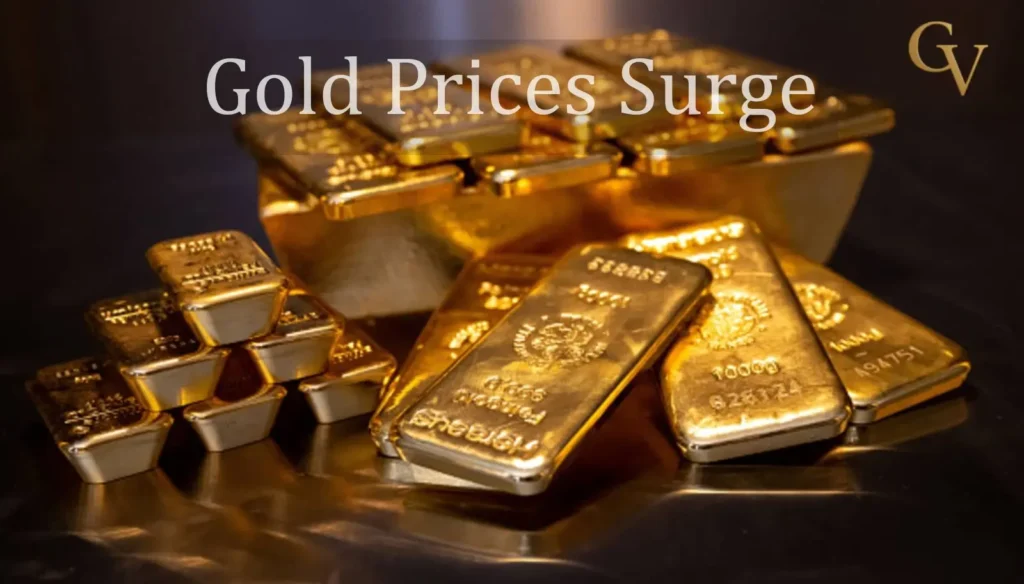
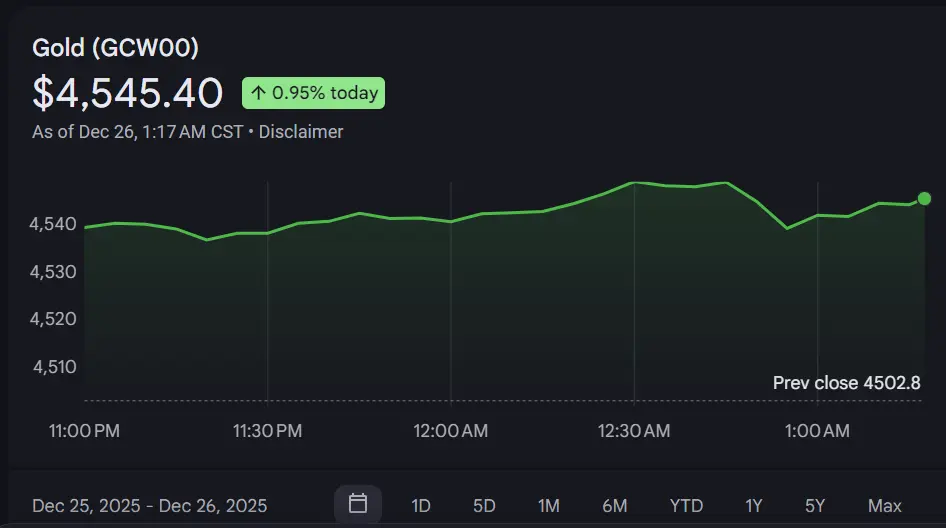
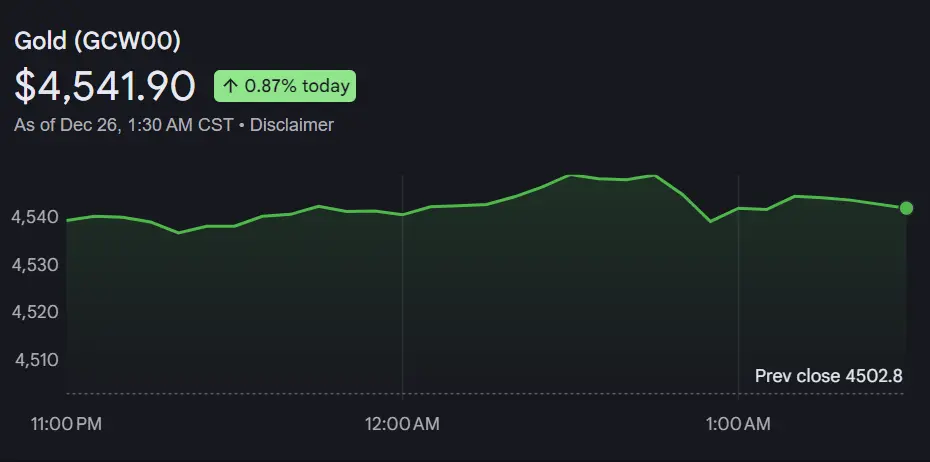
Gold prices have been rising sharply in late 2025, with U.S. gold futures climbing above $4,500 per ounce and spot gold making historic gains as investors seek safety amid global uncertainty and expectations of Federal Reserve rate cuts. This explosive rally reflects not just short-term trading but a broader shift in global markets—one that’s reshaping how Americans and international investors view precious metals as a cornerstone of diversified portfolios and hedge strategies.
Gold Prices Surge: Best Annual Performance Since the Jimmy Carter Era
Gold futures soared to new records in 2025, up nearly 71% year-to-date—the best performance since Jimmy Carter’s era amid tariffs, inflation, and geopolitical chaos—closing above $4,500/oz by December. Silver (+146%), platinum (+150%), and palladium (+100%) followed suit as safe-havens shine. For U.S. investors searching “gold price futures soar 2025 reasons” or “best year for gold since 1979,” GlobleVide charts track the rally in viral timelines.
Gold’s Record Rally Drivers
Trump’s tariffs (25%+ on imports) sparked trade turmoil, boosting gold as uncertainty hedge—Forbes ties it to $3,500 peaks despite strong U.S. growth. Inflation fears, dollar weakness, and central bank buys (1,000 tons past 3 years vs. 400-500 avg) fueled surges; CME notes defiance of high rates.. Geopolitics (Ukraine, Middle East) and recessions amplified demand.
2025 Price Timeline Highlights
- Early Year: $2,640 start; tariffs ignite climb.
- Mid-2025: $3,760 by Sept (Guardian), 43% YTD.
- Dec Peak: $4,500+; 71% gain sets 46-year record.
Precious metals mirrored: MCX gold hit ₹1,28,395/10g in India on similar cues.
Why Gold Thrives in Turmoil
Safe-haven status shines during crises—1979 parallel: oil shocks, inflation. Central banks (Russia, China, India, Turkey) diversify from USD; investors flee volatility. Bajaj Finserv lists economic slowdowns, wars, rupee weakness as boosters.
Impacts for U.S. Investors and Shoppers
Higher gold squeezes jewelry/wedding costs; 401(k)s with GLD/IAU gain, but volatility warns diversification. FT charts 2025’s “tariff turmoil, gold rush, sinking dollar.” GlobleVide investor reels simulate portfolios.
Outlook: More Gains Ahead?
JPMorgan eyes $2,950 EOY (adjusted); Goldman/Citi $3,000 mid-2026. Tariff escalations, Fed holds sustain rally—watch China buys, rate cuts. GlobleVide forecasts debate sustainability vs. correction.
Smart Plays Amid Gold Boom
Hedge with ETFs (GLD), physical bars; track “gold rally Trump tariffs 2025 impact.” History favors holders in chaos—position for 2026 uncertainties.
Record-Setting Rally: Price Action and Market Context
In late December 2025, gold prices broke through major milestones:
- Gold futures for February delivery traded above $4,500 per ounce, near historic highs.
- Spot gold hit peaks above $4,530.60 per ounce during early Asian trading before steadying, underpinning the strength of the rally.
- Silver and other precious metals also surged, with silver topping $75.14 per ounce as investors broadened their safe-haven positioning.
This year’s surge for gold marks one of its strongest annual performances since the late 1970s, driven by macroeconomic forces that go beyond short-term seasonal trading.
What’s Driving the Gold Price Rally?
1. Safe-Haven Demand Amid Geopolitical Uncertainty
Global tensions—ranging from conflicts in Eastern Europe to supply concerns linked to Venezuela and other hotspots—have prompted investors to move money into safe-haven assets like gold. Such demand increases when traditional markets feel unstable or unpredictable.
2. Weak U.S. Dollar and Lower Yields
Expectations that the U.S. Federal Reserve may cut interest rates in 2026—especially if economic data softens—have weakened the U.S. dollar. A weaker dollar makes dollar-priced commodities like gold more attractive to global buyers, amplifying upward pressure on metal prices.
Lower yields on U.S. Treasuries further enhance gold’s appeal as a hedge, since gold does not pay interest but benefits when bonds become less attractive.
3. Continued Safe-Haven Flows and Central Bank Buying
Investors often rush to gold when confidence in equities or sovereign credit wanes. Central banks around the world have continued purchasing gold to diversify reserves, adding structural demand to a market already buoyed by risk aversion.
4. Thin Holiday Liquidity and Market Volatility
Trading volumes are typically lower around Christmas and year-end holidays, meaning price moves can be exaggerated by thinner market participation. While this can prompt swings that feel dramatic, the broader trend remains rooted in deeper economic and geopolitical shifts.
How This Affects U.S. Investors
For Americans watching markets in 2025–26, this gold rally has several implications:
- Portfolio diversification: Gold and precious metals may help balance exposure against stock market volatility and bond yield uncertainty.
- Inflation and currency hedging: With inflation concerns still relevant and the dollar showing pressure, gold is often seen as a hedge against currency risk.
- Safe-havens and geopolitical fear: Rising geopolitical tensions can drive retail and institutional demand for gold, influencing commodities strategies into 2026.
Analysis by commodities strategists suggests that gold’s performance may continue to be strong if macroeconomic signals (like Fed rate expectations or geopolitical risk) persist, with some models even contemplating levels approaching $5,000 per ounce under certain conditions.
Gold Futures: How Traders See It
U.S. gold futures data show robust trading volumes and open interest, indicating that traders remain engaged and that positioning is shifting with sentiment. Some market watchers interpret the current structure as bullish, while others warn of profit-taking or corrections after such strong gains.
Gold Beyond 2025: What Analysts Expect
Looking toward 2026, several long-term themes could influence gold prices:
- Monetary policy: If the Fed does cut rates, gold’s safe-haven appeal could strengthen further.
- Economic uncertainty: Ongoing concerns about growth, debt levels, and currency stability often boost precious metals.
- ETF and central bank demand: Sustained demand from exchange-traded funds and reserve buyers can add structural support.
For readers tracking “gold price futures 2025–26” or exploring the role of precious metals in investment strategies, the surge in gold prices reflects not just short-term trading noise but broader shifts in global financial sentiment—a topic we’ll continue unpacking on GlobleVide with regular price updates and expert insights.
FAQs
