
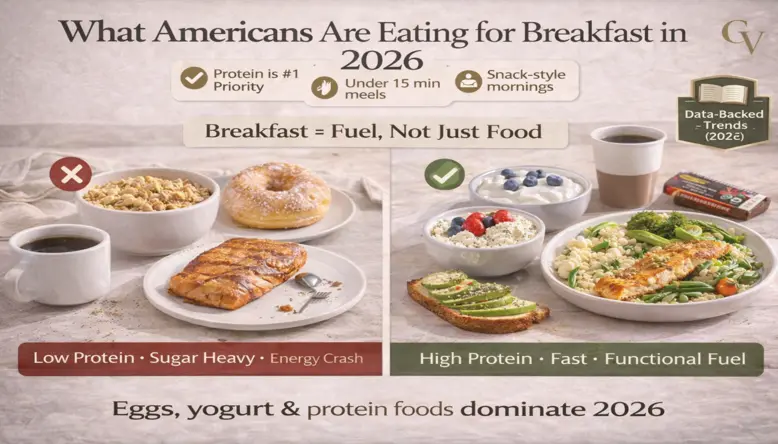
In This article we use research, the real data, and the honest truth about how American breakfast habits changed — and why protein is now driving the morning meal more than anything else.
What are Americans actually eating for breakfast in 2026?
In 2026, Americans are shifting away from sugar-heavy cereals, pastries, and skipped mornings toward high-protein, faster-to-prepare options. Eggs remain the most popular breakfast food across all age groups. Cottage cheese, Greek yogurt, and protein-enriched products are the fastest-growing breakfast categories. The global breakfast food market hit $210 billion in 2026. Two thirds of US adults eat breakfast on most mornings, but 63% of adults aged 18-34 prefer snacking in the morning over a sit-down meal. Protein is the number-one nutrition driver at breakfast in 2026, ahead of fiber, calories, and sugar reduction.
Key Takeaways
- The global breakfast food market reached $210 billion in 2026 and is projected to hit $255 billion by 2030 (Tastewise, 2026).
- Eggs remain the most popular breakfast food among American consumers in 2026. They also rank number one with Gen Z, the generation most likely to skip breakfast otherwise.
- High-protein options — poached eggs, cottage cheese, Greek yogurt — are driving a significant portion of breakfast-related social media shares in 2026, according to Tastewise data.
- 63% of breakfast eaters aged 18-34 prefer snacking in the morning rather than eating a full breakfast, signaling a structural shift away from the traditional sit-down morning meal (Mintel, 2025).
- 83% of daily breakfast eaters say eating a healthy breakfast gives them a sense of satisfaction — making breakfast a psychological anchor, not just a calorie occasion (Mintel, 2025).
- Americans consume the most protein at dinner (46%), with breakfast close behind at 34% — but the gap is closing fast as protein awareness grows (Undeniably Dairy / Talker Research, 2025).
- GLP-1 weight-loss drugs (Ozempic, Wegovy, Mounjaro) are now taken by roughly 1 in 8 American adults and are reshaping what the country eats at breakfast — particularly reducing high-fat morning foods and increasing demand for high-protein, small-portion options (KFF, 2025).
- Search interest for “high protein breakfast foods” peaked at index value 90 in January 2025 and remained elevated all year, suggesting sustained consumer interest beyond New Year resolution spikes.
Table of Contents
The State of American Breakfast in 2026: What the Data Actually Shows
American breakfast is going through a genuine identity crisis. And the data is finally specific enough to see what is happening clearly.
Two thirds of US adults eat breakfast on most mornings, according to Mintel’s 2025 Consumer Approach to Breakfast report. That sounds reassuring, but the shape of that breakfast has shifted dramatically. The scene of a family sitting down to pancakes or eggs together before school and work is increasingly a weekend or occasional event. On weekdays, most Americans are eating alone, eating fast, or not eating at all.
The numbers in full (Mintel / Tastewise / Talker Research, 2025-2026):
- 63% of breakfast eaters aged 18-34 prefer snacking in the morning over a full breakfast.
- 83% of daily breakfast eaters say a healthy breakfast gives them a sense of satisfaction.
- 51% of adults 55 and older prioritize health when choosing weekday breakfast items.
- 90% of morning meals are prepared in under 15 minutes (Circana).
- Breakfast transactions increased roughly 6% between 2023 and 2024.
- 34% of Americans eat breakfast every day. 54% say they would like to but do not (Kellogg survey, 14,000 respondents).
- Americans estimate protein makes up 37% of what they eat at breakfast on a typical plate (Talker Research, 2025).
The biggest structural shift is what Mintel calls the “snackification” of breakfast. What started in 2024 as grab-and-go product innovation became, by 2025, a full behavioral reorganization of morning eating. Mintel describes breakfast as “a flexible, fragmented eating occasion rather than a defined meal.” In plain English: breakfast no longer has a fixed shape. It is whatever you manage to eat between waking up and starting work, and for millions of Americans, that is increasingly a protein bar, a Greek yogurt cup, or a coffee and nothing.
The other major shift is from “breakfast as indulgence” to “breakfast as function.” In 2026, the dominant consumer mindset at breakfast is fuel, not pleasure. Consumers want their morning food to do something — sustain energy, provide protein, support focus, or manage weight. The era of breakfast cereals marketed on flavor alone is over. The era of breakfast marketed on what it does for your body has begun.
Market context: The global breakfast food market was valued at $210 billion in 2026 and is projected to reach $255 billion by 2030. North America dominates the category. Ready-to-eat breakfast products accounted for the largest market share in 2024 — and that segment is projected to grow from $10.78 billion to $15.82 billion by 2033 at a 4.5% compound annual growth rate, driven by busy lifestyles and the continued urbanization of the American workforce.
Why Protein Became the Defining Breakfast Priority in 2026
Protein has been trending in food and fitness culture for years. But 2026 is the year it decisively took over breakfast specifically. Understanding why tells you a lot about where American food culture is heading.
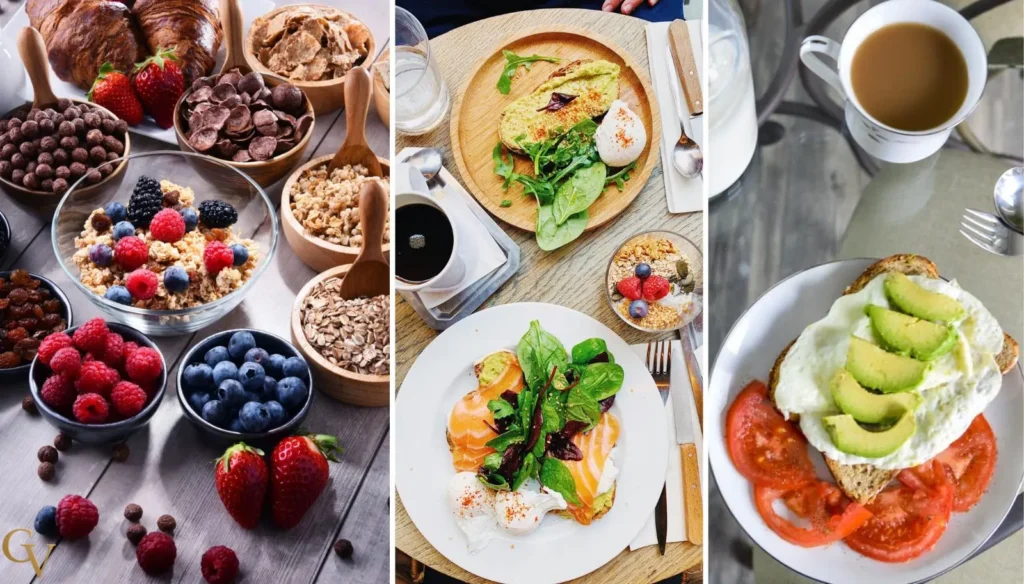
The New Dietary Guidelines Changed the Target
The 2025-2030 Dietary Guidelines for Americans, released in January 2026, raised the recommended daily protein intake from 0.8 grams per kilogram of body weight to 1.2-1.6 grams. For a 150-pound adult, this shift means the daily target moved from roughly 54 grams to 82-109 grams. Almost overnight, millions of Americans who thought they were eating enough protein realized they were significantly under the new guidance.
That realization landed hardest at breakfast, because breakfast is where the protein gap is biggest. Most Americans eat under 15 grams of protein at breakfast — eggs and toast, a bowl of oatmeal, or coffee and a pastry. To hit the new daily targets, breakfast needs to carry 25-35 grams of protein, not 10-15.
Social Media Turned Protein Into a Visual Category
TikTok and Instagram did something that no government guideline could: they made high-protein food visually interesting. Cottage cheese bowls, Greek yogurt parfaits, egg white scrambles with vegetables, and protein smoothies became content. They were photographed, shared, and replicated millions of times.
Google Trends data shows search interest for “high protein breakfast foods” peaked at an index value of 90 in January 2025 — the highest recorded — and remained elevated at 76 in October 2025, suggesting the interest is not just a New Year’s resolution spike but a sustained shift in consumer priorities.
The Satiety Science Became Mainstream
For years, researchers knew that protein at breakfast reduces hunger more effectively than carbohydrates or fat. It triggers greater satiety hormones and reduces ghrelin — the hunger hormone — more effectively than a carb-heavy start to the day. In 2025 and 2026, that science reached mainstream consumer awareness through dietitians on social media, wellness podcasts, and mainstream press coverage. Americans stopped just knowing that protein was “good” and started understanding specifically why it mattered at breakfast more than at any other meal.
Protein at breakfast — the specific science:
A 2025 scoping review found that consuming high amounts of protein at breakfast is associated with increased muscle mass, especially in adults losing weight. Breakfast protein has a stronger effect on preserving lean mass than protein consumed later in the day, because your body enters a catabolic (muscle-breakdown) state overnight and needs amino acids first thing in the morning to shift back to muscle building. The earlier you provide those amino acids, the more you reduce net muscle loss over a 24-hour period.
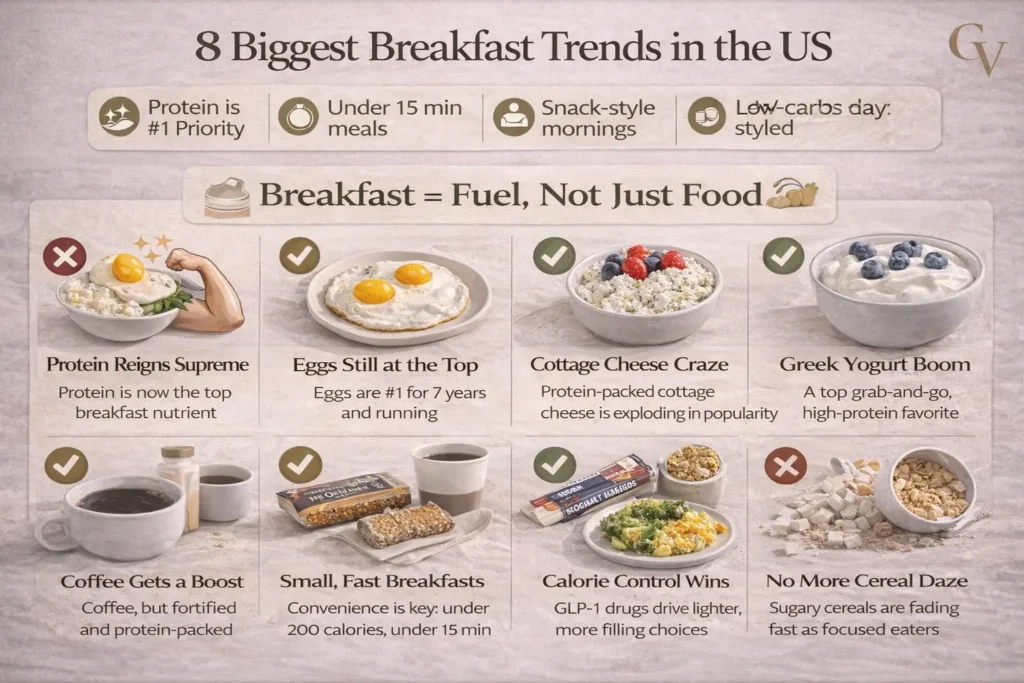
The 8 Biggest Breakfast Trends in the US Right Now
These are not passing fads. Each trend below is backed by sales data, search volume, or consumer survey evidence from 2025 and 2026.
Trend #1: The Cottage Cheese Comeback ★ Fastest-growing breakfast protein
Cottage cheese went from forgotten diet food to viral breakfast star. Instacart reported a 17% increase in cottage cheese sales in 2024. The trend continued and accelerated in 2025. Americans are using it in scrambled eggs, pasta sauces, pancakes, breakfast bowls, and straight from the container with berries. At around $0.80 per cup and 24 grams of protein, cottage cheese offers the best protein-per-dollar ratio of any dairy product.
Data: Instacart: 17% increase in cottage cheese sales in 2024.
Tastewise: cottage cheese appearing in a significant share of viral breakfast content in 2026.
Try it: Add half a cup of cottage cheese to your scrambled eggs. Blend it in before cooking. You get 12 extra grams of protein and the eggs become noticeably creamier. Most people cannot tell the difference.
Trend #2: Greek and Icelandic Yogurt Upgrades ★ High protein dairy surge
Standard Greek yogurt became table stakes. In 2026, Americans are upgrading to higher-protein versions: Icelandic skyr (which has roughly 17-20g protein per cup), Oikos Triple Zero (15g protein, no added sugar), and Fage 0% (20-24g protein per cup). Refrigerated yogurt saw 13.2% dollar sales growth in 2025, according to scanner data. The category is also expanding into drinkable yogurt for people who want protein without the sit-down moment.
Data: Refrigerated yogurt: 13.2% dollar sales growth in 2025.
Cheese Reporter: high-protein yogurt varieties are one of the fastest-growing dairy segments.
Try it: Choose Greek yogurt or skyr with over 15g protein per cup. Add chia seeds (5g protein per tablespoon) and you hit 20-25g of protein in a no-cook, 2-minute breakfast.
Trend #3: Savory Breakfast Shift ★ Sugar reduction driving behavior
The traditional American sweet breakfast — cereal, pastries, pancakes with syrup, flavored oatmeal — is losing ground. Consumers are increasingly aware of the blood sugar spike and crash that follows a carb-heavy sweet breakfast, and they are choosing savory alternatives. Eggs, vegetables, avocado, whole grain toast with nut butter, and globally inspired dishes like shakshuka and kimchi egg bowls are growing on US breakfast menus. Toast trends are also evolving: avocado toast is now a vehicle for eggs, smoked salmon, and ricotta.
Data: Food Navigator: savory breakfast preference growing fastest among health-conscious Millennials and Gen X. Tastewise: shakshuka, kimchi egg bowls, and spicy egg dishes showing rising menu appearances.
Try it: Replace your morning cereal or oatmeal with 3 scrambled eggs and a piece of whole grain toast with avocado and a sprinkle of everything bagel seasoning. Protein jumps from 4g to 22g with no extra time.
Trend #4: Breakfast Snackification ★ Structural behavior shift
Breakfast is no longer a meal for most Americans under 35. It is a collection of small eating moments between waking up and noon. A protein bar at 7am, a yogurt cup at 9am, a handful of nuts at 10:30am. This is not necessarily worse nutritionally than a single sit-down breakfast, but it requires different products and different thinking. In 2025, 63% of breakfast eaters aged 18-34 said they preferred snacking in the morning to eating a full breakfast. Brands are responding with single-serve portions, higher-protein grab-and-go items, and smaller packages designed for incremental morning eating.
Data: Mintel 2025: 63% of 18-34 year old breakfast eaters prefer morning snacking over full breakfast.
Refrigerated snack bars: 18.9% dollar sales growth in 2025.
Try it: If you snack in the morning rather than eating a full breakfast, aim to hit 15-20g of protein total across your morning snacks. A Greek yogurt cup (15-20g) plus a handful of almonds (6g) gets you there without a sit-down meal.
Trend #5: Functional and Adaptogenic Additions ★ Wellness-forward formulation
Americans are adding ingredients to their breakfast that are supposed to do specific things beyond basic nutrition. Matcha for calm energy without coffee jitters. Mushroom coffee (lion’s mane, chaga) for focus and immunity. Ashwagandha in smoothies for stress. Collagen powder in coffee for skin and joints. Kefir and fermented foods for gut health. This trend is most pronounced among health-conscious Millennials and Gen X, who are willing to pay a premium for breakfast ingredients that carry a functional promise. Across the board, research indicates that 61.59% of consumers choose functional food and drinks that enhance energy and focus.
Data: Tastewise 2026: matcha, mushrooms, ashwagandha, and kefir showing growing consumer interest in breakfast context. 61.59% of consumers choose functional food and drinks for energy and focus.
Try it: Start simple: add a tablespoon of chia seeds (5g protein, fiber, omega-3s) and a teaspoon of cinnamon (blood sugar regulation) to your Greek yogurt or oatmeal. Two ingredients, meaningful functional addition, no specialty store required.
Trend #6: Global Breakfast Flavors Going Mainstream ★ Adventurous eating at breakfast
The standard American breakfast — eggs, bacon, toast, or cereal — is no longer the only morning menu. Shakshuka (Middle Eastern poached eggs in spiced tomato sauce), Korean kimchi egg bowls, Japanese miso with eggs and rice, Mexican breakfast tacos, and South Asian masala omelets are appearing on American restaurant menus and in American home kitchens at growing rates. This is driven by a younger, more globally food-curious generation and by social media recipe sharing. Eggs are the common protein anchor in most of these international breakfast formats, which partly explains why eggs rank number one across all demographics.
Data:Washington Times / Business Research Company: global breakfast market diversification growing across all North American consumer segments.
Tastewise: international breakfast dishes showing increased menu features at US restaurants.
Try it: Try shakshuka if you have not. It is 2 eggs poached in a pan of canned tomatoes spiced with cumin, paprika, and garlic. Ready in 15 minutes, 14g protein, and tastes completely different from a standard egg breakfast.
Trend #7: Make-Ahead and Meal-Prepped Breakfasts ★ Sunday prep for weekday wins
More Americans are cooking breakfast once and eating it multiple times. Egg muffins, breakfast burritos, chia pudding, overnight oats, baked oatmeal, and sheet pan egg dishes are made on Sunday and grabbed throughout the week. This trend is growing because it solves the biggest breakfast problem Americans report: no time to cook in the morning. Circana data shows that 90% of Americans prepare their morning meals in under 15 minutes. Make-ahead options compress that even further — the morning moment is just reheating or grabbing from the fridge.
Data: Circana: 90% of morning meals prepared in under 15 minutes. Growing search volume for “breakfast meal prep” and “make-ahead breakfast” year over year.
Try it: Make 12 egg muffins on Sunday. Use a silicone muffin pan, fill each cup with 1 beaten egg, your choice of cheese, vegetable, and protein (turkey sausage, spinach, diced peppers). Bake 350°F for 20 minutes. Each muffin has 8-10g protein. Three muffins = a complete 24-30g protein breakfast you just grab from the fridge.
Trend #8: Protein-Enriched Cereal and Breakfast Products ★ Traditional formats getting a protein upgrade
The traditional cereal category is not disappearing — it is being reformulated. Protein-enriched cereals, high-protein granola, protein oatmeal packets, and cottage cheese pancake mixes are replacing their conventional counterparts on grocery shelves. Special K, Kashi, and newer brands have all launched protein-specific lines. Even Snickers launched a bar with 20g of protein in 2025. The drive is the same: consumers want their familiar formats to deliver protein numbers that previously only specialty sports nutrition products offered.
Data: Cheese Reporter 2025: protein-enriched breakfast cereals and dairy products among fastest-growing segments. Refrigerated snack bars: 18.9% dollar sales growth in 2025.
Try it: If you prefer cereal, switch to a protein-enriched option with at least 10g protein per serving and under 8g sugar. Add a cup of Greek yogurt on the side and you hit 25-30g protein while still eating what feels like a traditional breakfast.
For readers interested in building everyday meals around simple, traditional ingredients, our guide on How to Build a Healthy Grocery List on a Budget (U.S. Edition 2026) breaks down how staples like vegetables, grains, and proteins fit into affordable, balanced cooking.
What Different Generations of Americans Are Actually Eating for Breakfast
Breakfast habits differ more by generation than by almost any other demographic factor. Here is the breakdown based on 2025 and 2026 consumer research.
| Generation | Top breakfast foods | Key behavior | Protein priority |
|---|---|---|---|
| Gen Z (18-27) | Eggs, fruit, Greek yogurt, protein bars | 63% prefer snacking to a full breakfast. Highly influenced by social media. Most likely to eat globally inspired breakfast foods. | Growing fast. Eggs rank #1 with Gen Z breakfasters. TikTok protein trends driving product choices. |
| Millennials (28-43) | Eggs, cottage cheese, smoothies, avocado toast, overnight oats | Balancing convenience with health consciousness. Most likely to meal-prep breakfast. Snackification growing. | High priority. Most likely to read protein content on labels. Drive cottage cheese and Greek yogurt growth. |
| Gen X (44-59) | Eggs, Greek yogurt, oatmeal, protein shakes, coffee | Split between traditional breakfast eaters and health-upgraded routines. Increasingly home-based post-pandemic. | Moderate-high. Aware of protein for aging and muscle mass. Mintel: now least confident cohort overall. |
| Boomers (60+) | Eggs, toast, oatmeal, cereal, fruit, coffee | 51% prioritize health in weekday breakfast choices. Most committed to traditional sit-down breakfast structure. | High in older boomers who understand muscle loss risk with age. Dairy remains primary protein source. |
The clearest generational divide is around meal format. Older Americans still see breakfast as a defined meal at a defined time. Younger Americans increasingly see it as a nutritional window — a period of the morning where they consume whatever provides adequate protein, fiber, and calories regardless of whether it “looks like” breakfast.
Eggs cross every generational line. They are ranked number one by every age group in every major US breakfast survey from 2025 and 2026. Cottage cheese is the most generationally diverse breakout food of the last two years, beloved by fitness-focused Gen Z on TikTok, Millennial home cooks, and health-conscious Boomers alike.
The GLP-1 Effect on Breakfast: The Angle Most Articles Are Missing
This is the section you will not find in most breakfast trend articles. But it may be the most significant shift in American food behavior in 2026.
Roughly 1 in 8 American adults is currently taking a GLP-1 weight-loss medication — Ozempic, Wegovy, Mounjaro, or Zepbound — according to a November 2025 KFF poll. A Gallup survey found that the number of Americans taking these drugs more than doubled in the 18 months leading to late 2025, with 12.4% of respondents on the medications compared to 5.8% in early 2024.
By 2030, J.P. Morgan estimates more than 30 million Americans could be on a GLP-1 treatment. That is a population larger than the entire state of Texas eating differently — and breakfast is one of the meals most affected.
How GLP-1 Drugs Change Breakfast Behavior
- GLP-1 medications slow gastric emptying — food literally stays in the stomach longer. By morning, many users are still processing last night’s dinner. This makes eating a large traditional breakfast feel uncomfortable or impossible.
- A 2026 study of 332 adults (116 on GLP-1 medications) tracked 5,741 days of food intake. GLP-1 users ate significantly lower protein — about 54g per day versus 62g for non-users. Critically, they were “much more likely to skip breakfast, lunch, and dinner,” reducing opportunities for protein distribution across the day.
- GLP-1 users are shifting breakfast toward smaller, higher-protein, easier-to-digest options. Greek yogurt, protein smoothies, eggs on toast, and cottage cheese cups are replacing bacon, hash browns, and large egg scrambles.
- A CNBC analysis from March 2026 found breakfast has specifically taken a hit from high-income GLP-1 users — “fewer sugary coffee drinks and doughnuts” — while high-protein formats are gaining.
- GLP-1 users tend to spend more at restaurants and food service than before starting medication. They need convenient, appropriate options when cooking feels like too much. This is driving demand for protein-forward grab-and-go breakfast items at chains and delis.
Why this matters for breakfast specifically:
GLP-1 medications suppress appetite most strongly in the morning, when the stomach is still processing the previous evening’s food. Research shows that even GLP-1 users who are not hungry should still eat breakfast, because morning protein has a stronger effect on preserving muscle mass than protein at other meals. Skipping breakfast while on these medications compounds the muscle loss risk that already comes from rapid weight loss. Getting 20-25g of protein in a small, easily digestible form in the morning is the clinical recommendation for GLP-1 users.
The Breakfast Protein Gap: Why Most Americans Are Still Under-Performing at the Most Important Meal
Here is the uncomfortable truth that most breakfast trend articles avoid.
Americans consume the most protein at dinner — 46% of daily protein intake. Breakfast accounts for only 34%. That distribution is backwards from what the research supports.
A 2025 Talker Research survey of 5,000 Americans found that when protein intake falls short, people report:
- Low energy: 48% of respondents
- Low mood: 26%
- Midday crashes: 23%
- Brain fog: 21%
Those are the exact symptoms that most Americans attribute to “not being a morning person” or “needing more coffee.” The actual cause, in many cases, is eating 8-12 grams of protein at breakfast when the body needs 25-35 grams.
What the Typical American Breakfast Actually Contains
| Common US breakfast | Protein | Sugar | Problem |
|---|---|---|---|
| Bowl of cereal with milk | 6-10g | 12-28g | Protein far below threshold. Blood sugar spike followed by crash. |
| Bagel with cream cheese | 8-12g | 3-6g | High refined carbs. Minimal protein. 2-3 hours until hunger returns. |
| Flavored oatmeal packet | 4-5g | 12-17g | Less protein than one egg. High added sugar counteracts the fiber benefit. |
| Granola bar on the go | 3-6g | 10-20g | Marketing says “energy.” Nutrition says sugar bomb with minimal protein. |
| Coffee only (skip breakfast) | 0g | 0-20g | Zero protein. Cortisol spike. Muscle catabolism continues from overnight fast. |
| Eggs and toast (2 eggs) | 12-14g | 1-3g | Better, but still below the 25-30g threshold for meaningful satiety and muscle protein synthesis. |
| Greek yogurt + berries + chia | 22-28g | 8-12g natural | This works. Near or at the protein threshold with fiber, calcium, and antioxidants included. |
| 3 eggs + cottage cheese scramble | 30-34g | 2-3g | This is the target. 30+ grams, complete amino acids, sustained satiety for 4+ hours. |
The upgrade from a 10g protein breakfast to a 30g protein breakfast does not require cooking more food. It requires choosing differently. Greek yogurt instead of flavored oatmeal. Eggs with cottage cheese instead of eggs alone. A protein parfait instead of cereal. The swap takes the same time and costs a similar amount of money.
Real Experience: What Changed When I Overhauled My Breakfast for 6 Weeks
I write about nutrition and I track what I eat. So when I say “I tested this,” I mean I tracked every breakfast for six weeks using Cronometer, measured my energy and hunger levels at 10am and 2pm each day, and documented what happened.
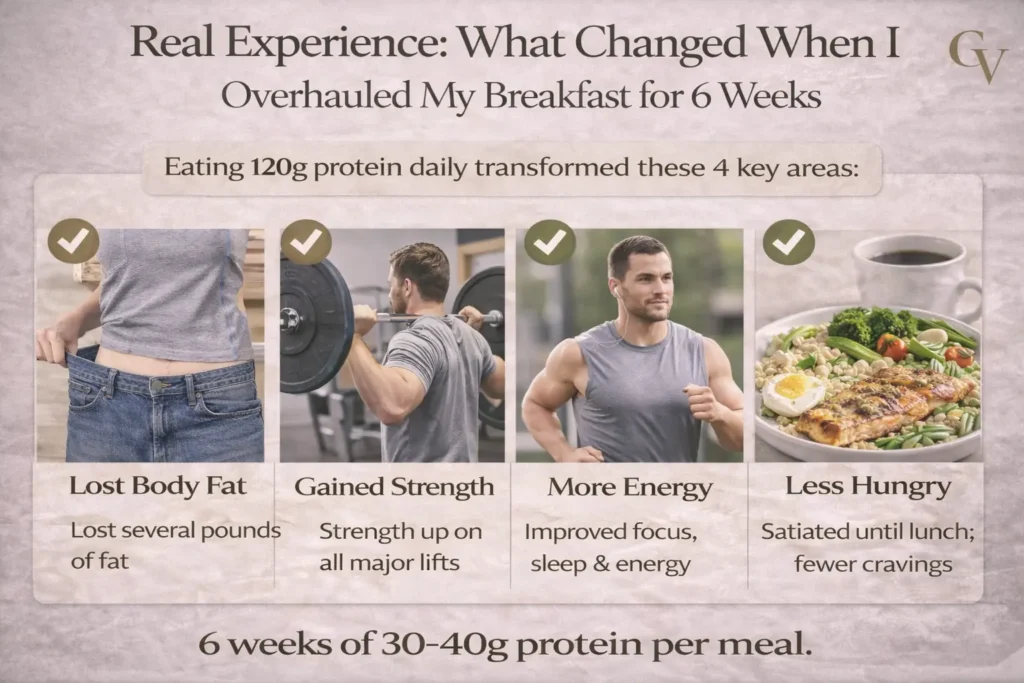
Starting point: I was a classic “coffee first, think about breakfast later” person. My average breakfast protein was 9 grams. Oatmeal some days, nothing other days, coffee always.
Weeks 1-2 — Getting to 25g+ at breakfast:
Switched to Greek yogurt (Fage 0%, 20g protein) with berries and a tablespoon of chia seeds. Added a hard-boiled egg on days I felt under-fueled. Total breakfast protein: 25-30g. Immediate observation by day 3: the 10am hunger that I had considered normal, “just how I am in the morning,” went away. Not reduced. Gone. First time I noticed it missing, I thought I had just forgotten to be hungry.
Weeks 3-4 — Adding the cottage cheese egg scramble:
Alternated between the yogurt bowl and a 3-egg scramble with half a cup of cottage cheese blended in. Protein range: 28-34g per morning. By week 3, my midday meal was smaller and I ate it later — around 1:30pm instead of noon. The 2pm energy dip I had assumed was just an afternoon personality trait was noticeably reduced. I stopped needing a second coffee every single afternoon.
Weeks 5-6 — The sustained result:
Mood was measurably more stable in the morning. I attribute this partly to stable blood sugar and partly to the fact that I was not starting every day in a slight cognitive deficit from being underfueled. Energy at 10am was the same as energy at 7am, which had never been true before. I was not losing weight or trying to, but my clothes fit differently — the kind of slow change that comes from better muscle maintenance. The Talker Research survey data that says low protein causes low mood, brain fog, and energy crashes matches exactly what I experienced in reverse when I fixed it.
A 2025 scoping review confirmed what I experienced: consuming high amounts of protein at breakfast is associated with increased muscle mass and better energy distribution across the day, especially in adults over 30. The research shows protein has a stronger effect on preserving lean mass when consumed at breakfast compared to protein consumed later in the day. My six weeks did not prove anything scientifically. But it matched the research precisely enough that I will not go back.
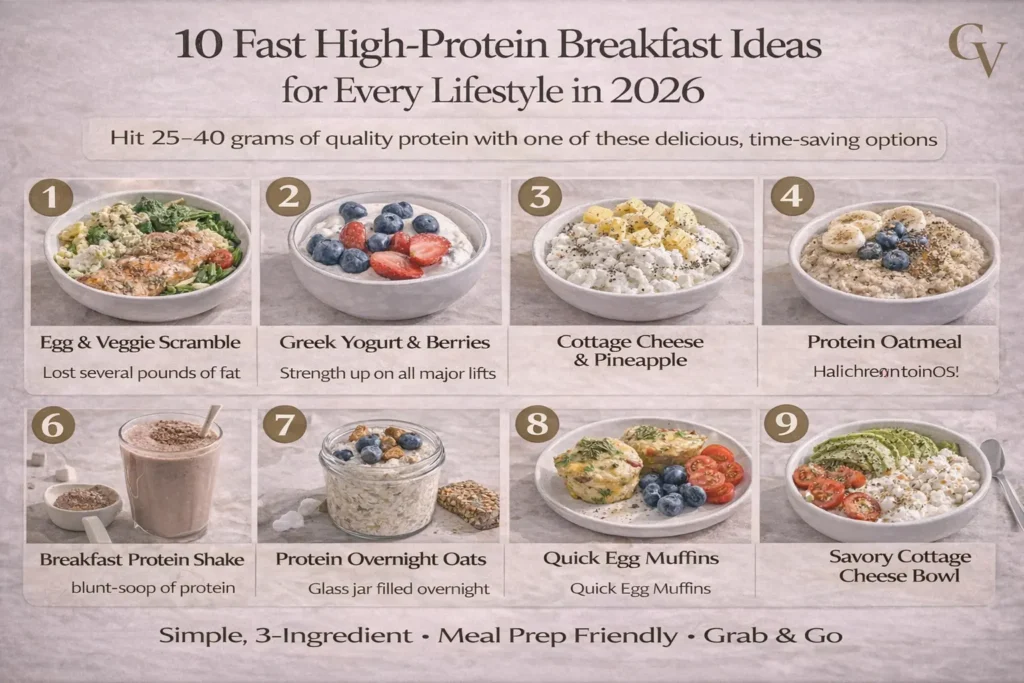
10 Fast High-Protein Breakfast Ideas for Every Lifestyle in 2026
Every option below is designed for real American mornings: fast, practical, and uses things you can buy at any grocery store.
1. Cottage Cheese Egg Scramble ⏱ 7 min | 30-34g protein | For: All skill levels
3 large eggs blended with ½ cup low-fat cottage cheese. Cook slowly over medium-low heat in butter. Top with everything bagel seasoning or hot sauce. This is the highest-protein, easiest cooked breakfast in this guide. The cottage cheese makes the eggs noticeably creamier and eliminates the need for any other protein addition.
2. Greek Yogurt Power Bowl (No Cooking) ⏱ 4 min | 24-28g protein | For: Grab-and-go, GLP-1 friendly
1 cup non-fat Greek yogurt (Fage 0%) layered with ½ cup berries, 1 tbsp chia seeds, and 1 tbsp granola. Optional: 1 tbsp almond butter for healthy fat. No cooking, no heating. Protein from yogurt and chia seeds alone. Add a scoop of vanilla protein powder stirred in if you need 40g+.
3. 5-Minute Smoked Salmon and Cream Cheese on Toast ⏱ 5 min | 28-32g protein | For: Pescatarians, savory lovers
2 slices whole grain toast. Spread 2 oz cream cheese. Top with 3 oz smoked salmon, capers, red onion, and a squeeze of lemon. No cooking. 28g protein before you add any extras. Smoked salmon provides omega-3 fatty acids alongside the protein, a combination most breakfast foods cannot match.
4. Shakshuka (Eggs in Spiced Tomatoes) ⏱ 15 min | 22g protein | For: Weekend breakfasts, global flavor trend
1 can diced tomatoes in a skillet with olive oil, minced garlic, cumin, and paprika. Simmer 5 min. Make 3 wells, crack an egg into each. Cover and cook 5-7 min until whites set. Top with feta and parsley. Serve with one slice of whole grain toast. One of the most satisfying breakfasts in this guide.
5. Overnight Protein Oats ⏱ 5 min prep night before | 20-25g protein | For: Meal preppers, busy mornings
Combine ½ cup oats, 1 cup Greek yogurt, ½ cup milk, 1 tbsp chia seeds, and ½ scoop protein powder in a jar. Stir. Refrigerate overnight. Top with berries in the morning. 100% ready when you open the fridge. 25g protein without turning on the stove.
6. Egg Muffins (Batch-Made Sunday) ⏱ 25 min Sunday, 2 min weekday | 22-30g per 3 muffins | For: Meal preppers, families
Whisk 8 eggs with salt, pepper, and your choice of fillings: diced turkey sausage + spinach, or diced peppers + cheese, or smoked salmon + dill. Pour into a silicone 12-cup muffin pan. Bake at 350°F for 18-20 min. Refrigerate. Microwave 3 of them for 60 seconds any morning. 3 muffins = 22-30g protein in under 2 minutes.
7. Turkey and Avocado Wrap (No Cooking) ⏱ 5 min | 32-35g protein | For: Desk breakfasts, time-pressed
1 large whole wheat tortilla. Spread 2 tbsp hummus. Layer 4 oz deli turkey (low sodium), ½ avocado sliced, 2 tbsp Greek yogurt, and baby spinach. Roll and wrap. Turkey provides 22g, hummus and yogurt add another 8-10g. This is the breakfast for people who think they cannot eat breakfast at a desk.
8. Protein Smoothie ⏱ 3 min | 30-40g protein | For: GLP-1 users, low appetite mornings
1 cup milk (dairy or fortified soy milk). 1 scoop protein powder (vanilla or chocolate). 1 tbsp nut butter. ½ banana or ½ cup frozen berries. Blend 30 seconds. 30-40g protein, completely liquid, digestible even when appetite is low. For GLP-1 users specifically, this is the most manageable high-protein morning option
9. Cottage Cheese Pancakes ⏱ 12 min | 28-32g for 4 pancakes | For: Weekend, family breakfast trend
Blend 1 cup cottage cheese, 2 eggs, ½ cup oats, and a pinch of salt until smooth. Cook in a non-stick pan like regular pancakes over medium heat, 2-3 min per side. Top with Greek yogurt and berries instead of syrup. The cottage cheese provides the protein base — these pancakes have nearly the same protein as a 4-egg scramble.
10. Hard-Boiled Eggs + Cheese + Apple ⏱ 10 min cook (or pre-made) | 18-22g protein | For: Budget-first, portable
3 hard-boiled eggs (make a batch of 6 Sunday). 1 oz cheddar or string cheese. 1 apple. This is the original portable high-protein breakfast. No prep in the morning if you cook the eggs ahead. 18g protein from eggs alone, 22g with cheese. Under $2 per serving. Works equally well at your desk, in the car, or at a coffee shop.
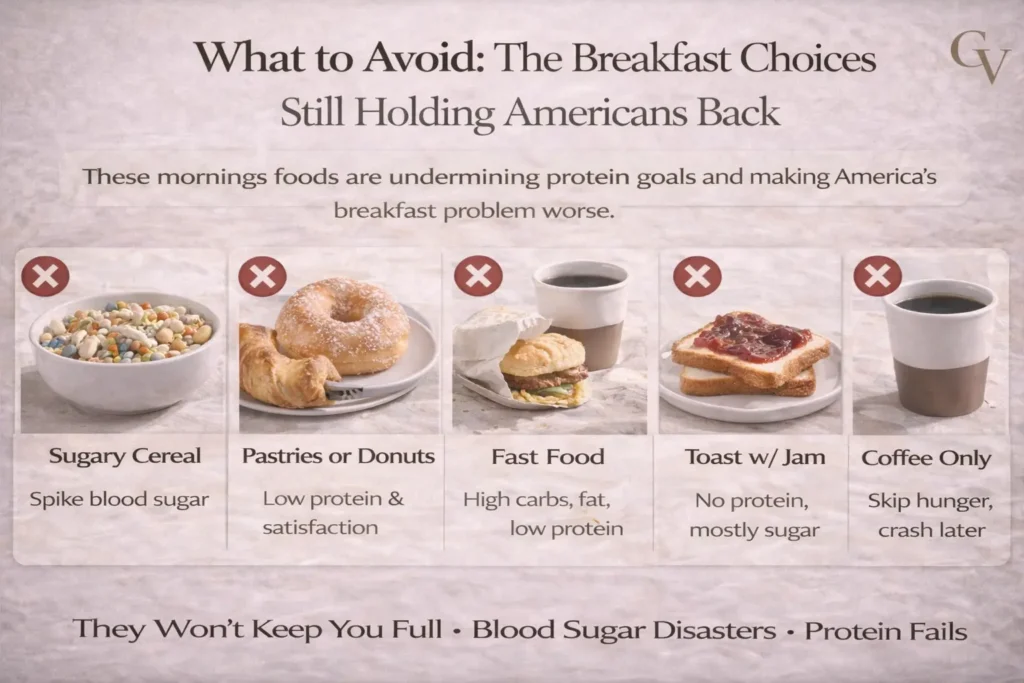
What to Avoid: The Breakfast Choices Still Holding Americans Back
These are the breakfast habits that are most common and most counterproductive. You do not need to eliminate them entirely, but understanding what they do to your morning is useful.
Flavored Oatmeal Packets
A plain oatmeal packet has about 5g of protein and 2g of sugar. A flavored version — maple brown sugar, apple cinnamon, peaches and cream — has the same 5g of protein and 12-17g of added sugar. The fiber benefit (3-4g) is real, but the sugar content drives a blood glucose spike that most people feel as energy, followed by a drop they feel as brain fog. If you eat oatmeal, choose plain rolled oats, add your own fruit, and pair it with Greek yogurt or a hard-boiled egg on the side to reach an adequate protein level.
Skipping Breakfast and Calling It Intermittent Fasting
Intermittent fasting has legitimate evidence behind it. Skipping breakfast because you are not hungry or ran out of time and calling it intermittent fasting is different. The distinction matters because intentional IF involves eating adequately within a specific window. Accidental breakfast skipping usually means you get to lunch depleted, overeat, and load too much protein at dinner — which is less effective for muscle maintenance and satiety than distributing it across three meals.
If you genuinely practice 16:8 intermittent fasting with intention, this does not apply to you. If you regularly skip breakfast and then wonder why you are tired by noon, the issue is not the fasting — it is the unintentional depletion.
High-Sugar Coffee Drinks as a Breakfast Substitute
A Grande Caramel Macchiato at Starbucks has 33g of sugar and 9g of protein. A Mocha Frappuccino has 50g of sugar and 5g of protein. These are desserts served in morning cups. They provide a caffeine hit alongside a sugar spike and crash, with almost no protein or satiety value. If your breakfast is a specialty coffee drink, you are starting your day with a blood sugar rollercoaster and zero amino acids for muscle maintenance. A plain latte has 10-14g of protein — a much better choice.
Protein Bars as a Breakfast Replacement
Many protein bars contain 20g of protein alongside 25-30g of sugar. The protein content is real. The sugar content is also real. More importantly, protein bars do not provide the satiety of whole food protein sources. They are processed food engineered to taste like a candy bar with protein added. Use them as a supplement when whole food is genuinely unavailable, not as a daily breakfast replacement.
Frequently Asked Questions
What are Americans eating for breakfast in 2026?
According to Tastewise and Mintel data, Americans are eating more eggs, cottage cheese, and Greek yogurt than any prior year. Eggs rank number one across all age groups. The savory breakfast trend is growing at the expense of sweet cereals and pastries. 63% of adults aged 18-34 prefer snacking in the morning over a sit-down breakfast, while older adults remain more committed to traditional breakfast structure. Protein is the dominant nutrition driver at breakfast in 2026, ahead of fiber, sugar reduction, and calorie management.
Is high-protein breakfast actually better for you?
Yes, with strong research support. A 2025 scoping review found that high protein at breakfast is associated with increased muscle mass, particularly in adults losing weight. Protein at breakfast reduces ghrelin (the hunger hormone) more effectively than carbohydrates or fat, reducing mid-morning hunger and delaying the next meal naturally. Harvard Health research shows that distributing protein across three meals — including an adequate amount at breakfast — produces better muscle maintenance than loading most protein at dinner, which is the current pattern for most Americans. The recommended target is 25-30g of protein at breakfast.
How much protein should I eat at breakfast?
Aim for 25-30 grams. The Mayo Clinic identifies this range as effective for stimulating muscle protein synthesis. The 2025-2030 Dietary Guidelines recommend 1.2-1.6g of protein per kilogram of body weight daily, and hitting that target requires distributing protein across three meals. For most adults, a 25-30g breakfast, 30-35g lunch, and 35-40g dinner, with 10-15g from snacks, reaches the daily total. Easy ways to hit 25-30g at breakfast: 3 eggs + ½ cup cottage cheese (30g), 1.5 cups Greek yogurt + chia seeds (26g), or a protein smoothie with milk and protein powder (30-35g).
Why are more Americans eating cottage cheese for breakfast?
Because it works nutritionally and it tastes good in a wide range of applications. One cup of low-fat cottage cheese has 24g of protein at about 180 calories and $0.80. Instacart reported a 17% sales increase in 2024 and the trend continued in 2025. TikTok drove much of the initial discovery, with creators using cottage cheese in scrambled eggs, pasta sauces, pancakes, and bowls. The nutritional case is strong enough that the trend has sustained beyond the viral moment.
What is a good breakfast for someone on a GLP-1 medication?
Small, protein-forward, and easy to digest. GLP-1 medications slow gastric emptying, so heavy, greasy, or high-fat breakfasts (bacon, hash browns, full egg scrambles) can cause nausea and discomfort. The best GLP-1 breakfast options are protein smoothies (30g protein, fully liquid, easy on the stomach), Greek yogurt cups (15-20g protein, soft texture), 1-2 eggs on whole grain toast, or cottage cheese with berries. Aim for 20-25g of protein even if appetite is low, because skipping breakfast on GLP-1s accelerates the muscle loss that comes with rapid weight loss.
Why do I get tired at 10am even after eating breakfast?
Almost certainly because your breakfast was too high in carbohydrates and too low in protein. A carb-heavy breakfast — cereal, pastry, flavored oatmeal, a bagel — causes a blood glucose spike followed by a drop around 2-3 hours later. That drop is the tiredness you feel at 10am. Protein and fat slow glucose absorption and produce a more stable energy curve across the morning. Switching from a cereal or oatmeal breakfast to eggs with cottage cheese or a Greek yogurt bowl typically eliminates the 10am crash within 3-5 days.
Is it bad to skip breakfast?
It depends on what comes next. Intentional intermittent fasting within a structured eating window has research support. Accidentally skipping breakfast because of rushing, then under-eating protein all morning, then overeating at lunch and dinner, is a pattern that works against most health and muscle maintenance goals. If you are not hungry in the morning, a small protein-forward option — a Greek yogurt cup or a protein smoothie — is more effective than skipping entirely, because it stops the overnight muscle protein breakdown without requiring a full meal.
What is the easiest high-protein breakfast that requires no cooking?
The easiest completely no-cook option is a Greek yogurt bowl: 1.5 cups of non-fat Greek yogurt (Fage 0% gives 20-24g protein), topped with berries and a tablespoon of chia seeds. Total protein: 26-28g. Total time: 3 minutes. If you want something even faster, deli turkey roll-ups (4 oz turkey + string cheese + a hard-boiled egg from a batch made Sunday) provide 32-35g of protein with literally 90 seconds of assembly. Both work at a desk, in a car, or standing at a kitchen counter.
Related Reading on GlobleVide
- High Protein Meals Under 30 Minutes: Complete US Guide (2026)
- Easy Chicken Recipes Under $15 for Busy Weeknights
- Meal Prep for Beginners: How to Prep a Full Week in 2 Hours
- Best Food Delivery Apps in the US 2026: Ranked and Reviewed
Sources
Tastewise. (December 2025/2026). Breakfast Trends in 2026: Sales and Data. tastewise.io
Mintel. (2025). US Consumer Approach to Breakfast Market Report 2025. store.mintel.com
Food Navigator USA. (February 2026). Breakfast Trends Shift from Products to Behavior. foodnavigator-usa.com
Undeniably Dairy / Talker Research. (January 2026). Protein Tops Americans’ 2026 Nutrition Priorities, survey of 5,000 US adults. scrippsnews.com
KFF Poll. (November 2025). 1 in 8 American adults currently taking GLP-1 medications. kff.org
Gallup National Health and Well-Being Index. (2025). GLP-1 adoption doubled in 18 months to 12.4% of respondents. gallup.com
CNBC. (March 2026). GLP-1 diets, restaurants, protein, fiber, weight loss drugs. cnbc.com
Today / NBC News. (April 2026). GLP-1 users eating critically low protein, skipping meals: study of 332 adults. today.com
Penn State Extension. (March 2026). Food Trends 2026: Comprehensive analysis. extension.psu.edu
Accio Research. (February 2026). Breakfast Consumer Trends 2025: Gen Z Impact and Market Shifts. accio.com
FlavorSum. (April 2025). What’s for Breakfast: Trends and Insights. Circana data cited. flavorsum.com
Cheese Reporter. (January 2025). The Protein Trend in 2025: Surge of Protein-Powered Foods. Instacart data cited. cheesereporter.com
Kellogg / Supply Side Journal. (2023). Only 34% of Americans Eat Breakfast. Survey of 14,000 respondents. supplysidesj.com
USDA and HHS. (January 2026). 2025-2030 Dietary Guidelines for Americans. dietaryguidelines.gov

Editorial Note: This article follows GlobleVide’s Editorial Policy and Fact-Checking Policy.